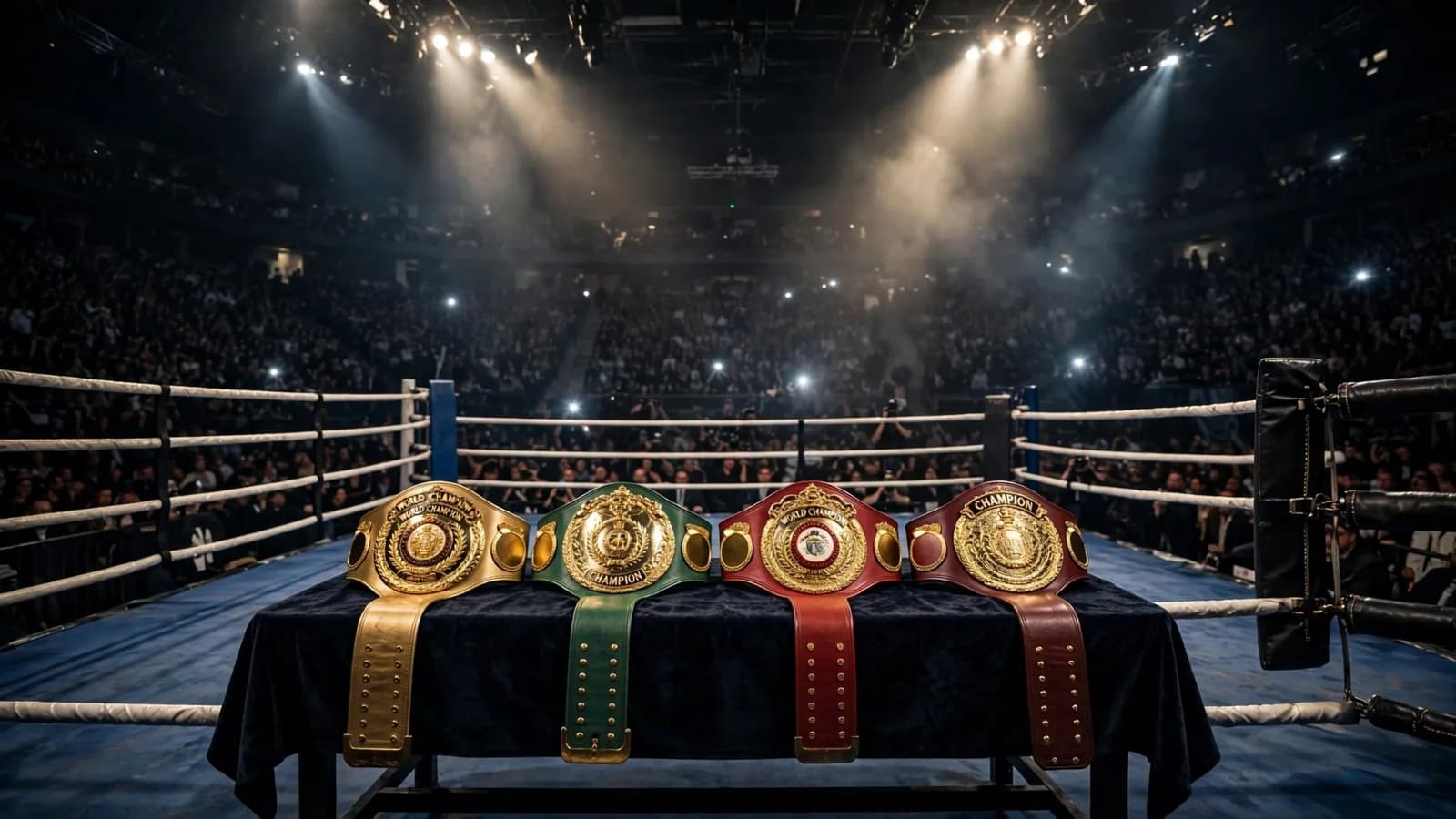
In boxing, "undisputed" is the strongest word in the sport — and the most misused. It does not mean unbeaten. It does not mean the best fighter alive. It means one thing, exactly: a single boxer holding all four major world titles in one weight division at the same time. The WBA belt, the WBC belt, the IBF belt and the WBO belt, all in the same hands, on the same night.
“Undisputed is not a belt. It is a situation: one boxer holding every major title in a division at once.”
That is a harder thing to do than it sounds. Eleven men have done it in the four-belt era, counting from Hopkins in 2004. The women's list is longer, and still growing. And as of November 2026, only one man in the sport holds the status: Naoya Inoue, at super bantamweight. Everybody else has lost it, vacated it, or been stripped of it — usually within months of winning it.
This is the story of what undisputed means, who the four bodies are, who has done it, and why the crown keeps falling apart.
Four belts, one night
The definition is modern. Before 2007 there was no four-belt era to speak of, because the four bodies did not all recognise each other. The WBO, founded in 1988, was the last to be accepted: the WBA was giving its champions equal recognition by 2000, the WBC began listing WBO champions in its rankings in 2004, and the IBF — the last holdout — recognised the WBO by February 2007. That is the date most historians use for the start of the four-belt era, and it comes with a wrinkle: Bernard Hopkins had already held all four belts by then, beating Oscar De La Hoya for the WBO middleweight title on 18 September 2004. Hopkins was the first man to hold all four major titles at once — three years before the era is usually dated to begin.
Before that, undisputed meant three belts: the WBA, the WBC and the IBF, the three bodies that existed from the IBF's founding in 1983 until the WBO joined the club. Lennox Lewis was the last three-belt undisputed heavyweight, beating Evander Holyfield in November 1999 — and the WBA stripped him five months later for facing Michael Grant instead of its mandatory challenger, John Ruiz. Kostya Tszyu did it at light welterweight in 2001, stopping Zab Judah in two rounds, and Roy Jones Jr did it at light heavyweight in 1999. The belts that do not count are the rest of the alphabet: the IBO, the IBU and the World Boxing Foundation are disregarded. Four bodies, four belts, one champion. Everything else is decoration.
The four bodies
The four bodies are separate organisations with separate rankings, separate rulebooks and separate fees, and they were not founded together. The WBA is the oldest, founded in 1921 as the National Boxing Association and renamed the World Boxing Association in 1962. It is headquartered in Panama City, and its president is Gilberto Mendoza Jr. The WBC was founded on 14 February 1963 in Mexico City, where it is still headquartered, and its president is Mauricio Sulaimán. Its green-and-gold belt is the most recognisable in the sport — the look was established with the second-generation belt, unveiled in 1976. The IBF was founded in 1983, after a split from the WBA, and is headquartered in Springfield, New Jersey, under president Daryl Peoples. Its belts are red for men and light blue for women. The WBO is the youngest, founded in 1988 after breaking away from a WBA convention in Venezuela; it is headquartered in San Juan, Puerto Rico, under president Gustavo Olivieri, and its belt is a dark maroon strap with a gold globe centrepiece. All four are recognised by the International Boxing Hall of Fame as the major sanctioning bodies. Nothing else counts.
The WBA has spent the last quarter-century making its own titles harder to explain than anyone else's. It created the "Super" champion designation in 2000, after Lennox Lewis suggested it, and awarding a Super title vacated the regular title — creating two WBA champions in one division. By the autumn of 2021 the WBA recognised up to four world champions in a single weight class: in December 2019, at heavyweight, it simultaneously recognised a Super champion in Anthony Joshua, a regular champion in Manuel Charr, an interim champion in Trevor Bryan and a Gold champion in Robert Helenius. In August 2021 the Association of Boxing Commissions wrote to the WBA calling the multiple titles "misleading to the public and the boxers", and the WBA declared all of its interim titles vacant and ordered tournaments to find single champions. It did not hold: the WBA went back to issuing interim titles in 2024. The WBA even deleted a whole division in 2026, eliminating bridgerweight on 30 June and leaving it a WBC-only division.
Undisputed is not unified is not lineal
The words get swapped constantly, and they are not the same thing. A unified champion holds two or more of the four major titles, but not all four — every undisputed champion is unified, but most unified champions are not undisputed. A boxer holding the WBA, WBC and IBF belts while someone else holds the WBO is a unified champion with one belt still to collect.
Lineal is something else entirely: "the man who beat the man", a lineage rather than a belt. A lineal champion is made only by beating the previous lineal champion in the ring, and when a sanctioning body strips a title, the lineal reckoning disregards it. A fighter can be undisputed without being lineal, and a lineal champion can hold one belt, or none, if the organisations have stripped him. The Ring magazine's title does not count toward undisputed either. The Ring began awarding championships in 1922, stopped in 1990, resumed in 2002, charges no sanctioning fees, and fills its vacant titles only with bouts between its top-ranked contenders — prestigious, but outside the criteria.
And then there is the asterisk factory. In June 2019 the WBC introduced the "Franchise" champion designation, an honorary title awarded only by appointment of its Board of Governors. A Franchise champion must vacate the WBC world title in that division — which is how Vasiliy Lomachenko gave up the WBC lightweight belt to become Franchise champion, how Devin Haney was promoted from interim to full champion, and how Teofimo López then beat Lomachenko holding the Franchise belt rather than the full one. López was called undisputed by some and not by others, and the argument has never really been settled. That is what the alphabet does to plain words.
The roll of honour
Hopkins was the first man to hold all four belts, and he had already been the three-belt undisputed middleweight champion since 29 September 2001, when he stopped Félix Trinidad in twelve rounds to add the WBA title to his WBC and IBF belts — the first undisputed middleweight since Marvin Hagler in 1987. Jermain Taylor took all four belts from Hopkins on 16 July 2005, and held them for less than three months.
The man who has done it most often is Terence Crawford, the only man to become undisputed champion in three weight classes in the four-belt era. He did it at light welterweight in August 2017, stopping Julius Indongo in three rounds; at welterweight in July 2023, stopping Errol Spence Jr in nine; and at super middleweight in September 2025, outpointing Canelo Alvarez over twelve rounds to take all four belts in a single night. He was stripped of the WBC super middleweight title on 3 December 2025 for failing to pay sanctioning fees, and retired thirteen days later, unbeaten at 42-0.
Oleksandr Usyk has done it in two divisions. He unified the cruiserweight division in July 2018, outpointing Murat Gassiev over twelve rounds, and then became the first undisputed heavyweight champion of the four-belt era in May 2024, beating Tyson Fury by split decision — the first undisputed heavyweight since Lennox Lewis in 1999. He lost the status five weeks later, vacating the IBF belt rather than face mandatory challenger Daniel Dubois so he could rematch Fury, and regained it in July 2025 by knocking Dubois out in five rounds at Wembley. Canelo Alvarez became undisputed super middleweight champion in November 2021, stopping Caleb Plant in eleven rounds; the IBF stripped him in July 2024 for fighting Edgar Berlanga instead of mandatory William Scull, he regained the belt by beating Scull in May 2025, and then lost all four to Crawford that September.
Naoya Inoue is the man still standing. He became the first undisputed bantamweight champion of the four-belt era in December 2022, knocking out Paul Butler in eleven rounds, and the first undisputed champion from Asia in the four-belt era. A year later he did it again at super bantamweight, stopping Marlon Tapales in ten rounds in December 2023. He is the only men's undisputed champion left.
The rest of the men's list is a study in short reigns: Josh Taylor at light welterweight in May 2021, stripped of the WBA a year later; Jermell Charlo at super welterweight in May 2022, stripped of the WBO sixteen months later; Devin Haney at lightweight in June 2022, moved up over a year later; Artur Beterbiev at light heavyweight in October 2024, beaten by Dmitry Bivol in the rematch four months later — and Bivol then vacated the WBC himself in April 2025 to chase the trilogy instead of facing interim champion David Benavidez.
The women got there first. Cecilia Brækhus was the first boxer to hold all four belts after the four-belt era's conventional start, unifying the welterweight titles in September 2014. Claressa Shields is the first boxer, male or female, to become undisputed in three weight classes: middleweight in April 2019, super welterweight in 2021, and heavyweight in February 2025, when she outpointed Danielle Perkins over ten rounds. Katie Taylor became undisputed lightweight champion in June 2019, beating Delfine Persoon by majority decision at Madison Square Garden, and added the super lightweight crown in November 2023. Gabriela Fundora is the youngest four-belt undisputed champion in history, aged 22 years and 218 days when she stopped Gabriela Celeste Alaniz in seven rounds in November 2024. Around them: Amanda Serrano and Alycia Baumgardner both completed the set on the same card in February 2023, Chantelle Cameron in November 2022, Savannah Marshall in July 2023, Franchon Crews-Dezurn in April 2022, Jessica McCaskill in August 2020, Seniesa Estrada in March 2024 and Tina Rupprecht in April 2025.
Why it never lasts
Four bodies means four mandatory challengers, four sets of fees and four chances to be stripped. The four bodies have agreed a rotation system to order the mandatory defences of an undisputed champion — the IBF's turn came due in 2024, which is what cost Canelo his belt. Each body typically takes three percent of a fighter's purse when it sanctions a title fight, so a four-belt fight costs a champion and a challenger twelve percent each: Crawford and Indongo paid more than $100,000 apiece in sanctioning fees for their undisputed fight in August 2017. Refuse a mandatory and the belt goes. That is not a threat; it is the sport's most reliable mechanism.
The roll of the stripped is long. Tyson Fury won the WBA, IBF and WBO heavyweight titles from Wladimir Klitschko in November 2015 and lost the IBF belt ten days later, because he chose Klitschko's contractual immediate rematch over mandatory challenger Vyacheslav Glazkov. Canelo was stripped of the IBF middleweight title in August 2019 after negotiations for his mandatory defence against Sergiy Derevyanchenko collapsed, and of the IBF super middleweight title in July 2024. Usyk gave up the IBF belt five weeks after becoming undisputed heavyweight champion. Josh Taylor lost the WBA belt for failing to sign against mandatory Alberto Puello. Jermell Charlo lost the WBO belt for fighting Canelo instead of mandatory Tim Tszyu. Jermain Taylor was stripped of the IBF title for agreeing to a Hopkins rematch instead of facing his mandatory. Many undisputed reigns end not with a defeat but with a letter.
The state of play, November 2026
As of November 2026, the men's divisions hold a single undisputed champion: Inoue, at super bantamweight. Every other men's division is split. Heavyweight is split four ways — the WBA (Super) title is vacant, with Murat Gassiev holding the WBA regular title, the WBC belt belongs to Agit Kabayel, the IBF to Filip Hrgovic and the WBO to Daniel Dubois. Usyk, the two-time undisputed heavyweight champion, holds none of the four belts; he vacated the WBO title in November 2025 and his remaining three belts in June 2026, keeping only The Ring championship. At light heavyweight, Bivol holds the WBA, IBF and WBO titles while the WBC belt belongs to Willy Hutchinson, who won the vacant title in November 2026.
The women's picture is healthier. Four women hold undisputed status: Shields at heavyweight, Taylor at junior welterweight, Dina Thorslund at bantamweight and Fundora at flyweight.
That is the paradox of the word. Undisputed is the hardest title in boxing to win and the easiest to lose, because winning it means satisfying four organisations that have never agreed on anything except the price — and because the moment a champion holds all four belts, four different challengers hold a contractual claim on his next fight. The belts are the map. The champion is the territory. And in boxing, the map keeps getting redrawn.