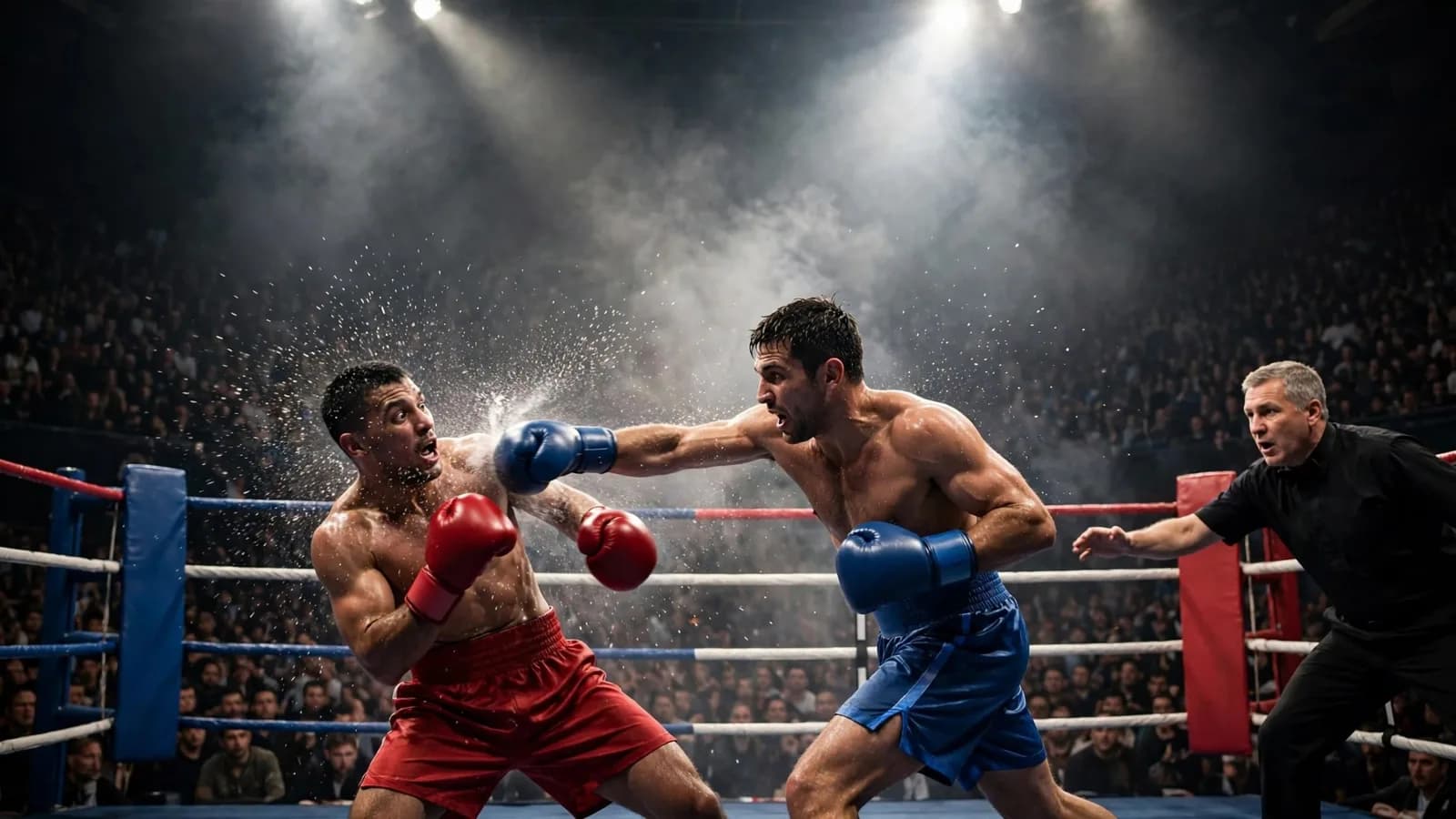
Power is the one thing in boxing that cannot be taught. Footwork can be drilled. Defence can be learned. Timing can be sharpened over a thousand rounds in the gym. But the ability to end a fight with a single punch — to take a man who has never been stopped and put him on the canvas — is something a fighter is born with. The eight men below are the hardest punchers the sport has seen. Between them they won 476 fights, and 415 of those wins came by knockout. What follows is not a ranking. Power does not rank neatly: a heavyweight's right hand and a middleweight's left hook are different weapons. What these eight share is simpler. When they landed clean, the fight was over.
“"Earnie hit me so hard, it shook my kinfolk back in Africa."”
Earnie Shavers. Ask the men who fought him and the answer is nearly unanimous: Earnie Shavers hit harder than anyone. Muhammad Ali, who fought George Foreman and Joe Frazier, called Shavers the hardest puncher he ever faced, and said of one Shavers punch: "Earnie hit me so hard, it shook my kinfolk back in Africa." Larry Holmes, who was knocked down by Shavers in their 1979 fight and got up to win, said forty years later that he still felt it. Even Foreman, who never fought Shavers, said: "I never fought Earnie Shavers. Thank goodness." Shavers knocked out 68 men — some sources credit him with 70 — and his best knockouts came in a hurry. He stopped Jimmy Ellis in the first round, in 2:39, on 18 June 1973 at Madison Square Garden. He stopped Jimmy Young in three rounds on 19 February 1973. And on 23 March 1979 he flattened Ken Norton, a man who had gone the full distance with Ali three times, in one round, in 1:58. Shavers never won a world title. He fought for it twice and lost twice. But nobody who shared a ring with him ever questioned the power. It was, by the testimony of the men who felt it, the hardest single punch in boxing history.
George Foreman. Foreman's power was not a single punch. It was a system. He walked forward behind a jab like a telephone pole, cut off the ring, and threw hooks and uppercuts that moved men across the canvas. His record was 76-5, with 68 knockouts — 89.5 per cent of his wins. The night that announced him was 22 January 1973 in Kingston, Jamaica, when he challenged Joe Frazier for the undisputed heavyweight title. Frazier had never been beaten, never been knocked down. Foreman knocked him down six times in two rounds and stopped him at 1:35 of the second. Fourteen months later he did nearly the same to Ken Norton, dropping him three times in the second round and stopping him at 2:00 on 26 March 1974. Foreman lost the title to Ali in Zaire, retired, came back ten years later, and at 45 years old knocked out Michael Moorer in the tenth round — at 2:03 on 5 November 1994 — to become the oldest world heavyweight champion in history. Evander Holyfield, who beat Foreman on points in 1991, said Foreman hit him harder than anyone ever did: "He hit me one time in the eleventh round, and I came back to the corner and I said, 'did he knock all my teeth out?'" The Ring ranked Foreman the ninth-greatest puncher of all time. The punch that beat Moorer, thrown by a 45-year-old, is the best argument for the ranking.
Mike Tyson. No puncher ever arrived the way Tyson did. He won his first 19 professional fights by knockout, 12 of them in the first round, and by the time he fought for a title he was already the most feared man in the sport. On 22 November 1986 he stopped Trevor Berbick in the second round, at 2:35, to win the WBC heavyweight title — at 20 years and four months, the youngest heavyweight champion in history. He added the WBA and IBF titles to become the first heavyweight to hold all three at once, and he held the undisputed championship from 1987 to 1990. His record was 50-7, with 44 knockouts — 88 per cent of his wins. The knockouts were not just fast, they were violent in a way that changed how opponents fought him: Marvis Frazier lasted 30 seconds on 26 July 1986. Michael Spinks, the undefeated lineal champion, lasted 91 seconds on 27 June 1988. Tyson's power came from speed as much as strength — a short, compact man who threw combinations other heavyweights could not see, let alone stop. The fear he inspired was part of the weapon. Fighters lost to Tyson before the first bell, because they knew what was coming, and knowing did not help.
Deontay Wilder. No heavyweight champion in history has knocked out a higher share of the men he beat. Wilder won 45 fights and stopped 43 of them — 95.6 per cent, the highest knockout ratio of any heavyweight champion. His right hand, thrown long and straight, ended fights from distances where other men were still measuring. He won his first 32 professional fights by knockout; his first decision win came only when he won the WBC title from Bermane Stiverne on 17 January 2015. He held that title from January 2015 to February 2020 and defended it ten times. Twenty of his 43 knockouts came in the first round. The signature wins tell the story: Luis Ortiz, badly hurt in the seventh round of their first fight on 3 March 2018, stopped in the tenth at 2:05. Dominic Breazeale, knocked out in the first round, at 2:17, on 18 May 2019. And the rematch with Ortiz on 23 November 2019 — a single right hand in the seventh round, at 2:51, that won The Ring's Knockout of the Year. Wilder's power was raw and unpolished, and that was the point. He did not need combinations. He needed one opening, and one punch.
Julian Jackson. They called him "The Hawk", and his right hand was the most feared single punch below heavyweight. Jackson's record was 55-6, with 49 knockouts — 89 per cent of his wins, and 80 per cent of all his fights. He won world titles in two weight classes and held them three times: the WBA super welterweight title from 1987 to 1990, and the WBC middleweight title twice, from 1990 to 1995. The knockout that defines him came on 24 November 1990 in Benalmádena, Spain, against Herol Graham. Graham was outboxing him, ahead on the cards, and winning the fight — and then Jackson landed one right hand in the fourth round, at 1:13, and Graham was unconscious before he hit the canvas. It is still shown in every compilation of the greatest knockouts ever filmed. Jackson did the same to Baek In-chul, stopping him in three rounds on 21 November 1987 to win his first world title, and to Terry Norris, stopped in two rounds on 30 July 1989. He started his career 29-0, with 27 knockouts. The Ring ranked him the 25th-greatest puncher of all time, and he was inducted into the International Boxing Hall of Fame in 2019. Jackson's lesson is the purest one in this list: a puncher does not need to be winning to win. He needs one punch, and one second.
Thomas Hearns. Hearns was the longest, sharpest puncher on this list — a tall, thin welterweight with a right hand that looked like it came from a heavyweight. They called him "The Hitman" and the "Motor City Cobra", and he began his professional career with 17 straight knockouts. His record was 61-5-1, with 48 knockouts. He won his first world title by stopping José "Pipino" Cuevas in the second round, at 2:39, on 2 August 1980, ending a four-year reign. But the knockout that made his legend came on 15 June 1984 at Caesars Palace, against Roberto Durán. Durán had never been knocked out. Hearns knocked him out in the second round, at 1:07, with a right hand that left Durán flat on his back — the first fighter ever to knock Durán out. Hearns went on to stop Juan Roldán in four rounds on 29 October 1987 to win the WBC middleweight title, becoming the first man to win world titles in four weight divisions. He eventually won titles in five — welterweight, light middleweight, middleweight, super middleweight and light heavyweight — the first boxer in history to do so. The Ring named him Fighter of the Year in 1980 and again in 1984. His power was not brute force. It was leverage, timing and spite, delivered from a distance no opponent could reach.
Rocky Marciano. Marciano is the only heavyweight champion in history to retire undefeated: 49-0, with 43 knockouts — 87.76 per cent, one of the highest knockout ratios of any heavyweight champion. He was not fast, not tall, and not pretty. He was relentless. He walked through punches to land his own, and his own punches broke men down. The fight that won him the title is the most famous single punch in heavyweight history: on 23 September 1952, against Jersey Joe Walcott in Philadelphia, Marciano was behind on all three scorecards going into the thirteenth round. Then he landed a short right hand, and Walcott fell at 0:43 of the round. The rematch, on 15 May 1953, lasted one round — Walcott stopped at 2:25. Marciano's last fight, on 21 September 1955 against Archie Moore, summed him up: floored in the second round, he got up, floored Moore in the sixth and eighth, and stopped him in the ninth at 1:19. Four years earlier he had ended Joe Louis's career, stopping the former champion in eight rounds on 26 October 1951. Marciano retired on 27 April 1956, aged 32, with his record intact. The Ring ranked him the 14th-greatest puncher of all time. He never lost a fight, and he stopped every man he ever faced for the world heavyweight title.
Joe Louis. Louis is the standard against which every heavyweight puncher is still measured, because his power was complete: fast, accurate, balanced, and delivered in combinations that ended fights in seconds. His record was 66-3, with 52 knockouts. He won the world heavyweight title by stopping James J. Braddock in the eighth round on 22 June 1937 — Braddock had floored him in the first, and it was the only time Braddock was ever knocked out. Then Louis did something no champion in any weight class has matched: 25 consecutive title defences, across a reign of 11 years and 8 months, the longest single reign of any boxer in history. The most famous night of that reign was 22 June 1938, the rematch with Max Schmeling at Yankee Stadium. Schmeling had handed Louis his only defeat to that point. Louis knocked him down three times and stopped him in the first round, at 2:04 — 124 seconds that carried the weight of a world on the edge of war. President Roosevelt had told Louis before the fight: "Joe, we need muscles like yours to beat Germany." Louis's last great knockout came a decade later, on 25 June 1948, when he stopped Jersey Joe Walcott in the eleventh round to keep his title. He was not the hardest single puncher on this list. He was the best puncher — the one whose power worked against everyone, for longer, and under more pressure, than anyone else's.
That is the difference between hitting hard and being a knockout artist. Shavers hit the hardest. Foreman hit the most relentlessly. Tyson hit the fastest. Wilder hit the most often. Jackson hit the most suddenly. Hearns hit from the furthest away. Marciano hit until there was nothing left to hit. Louis hit the best. Power, in the end, is not a number. It is a fact the other man learns in the ring, usually too late, and usually only once.