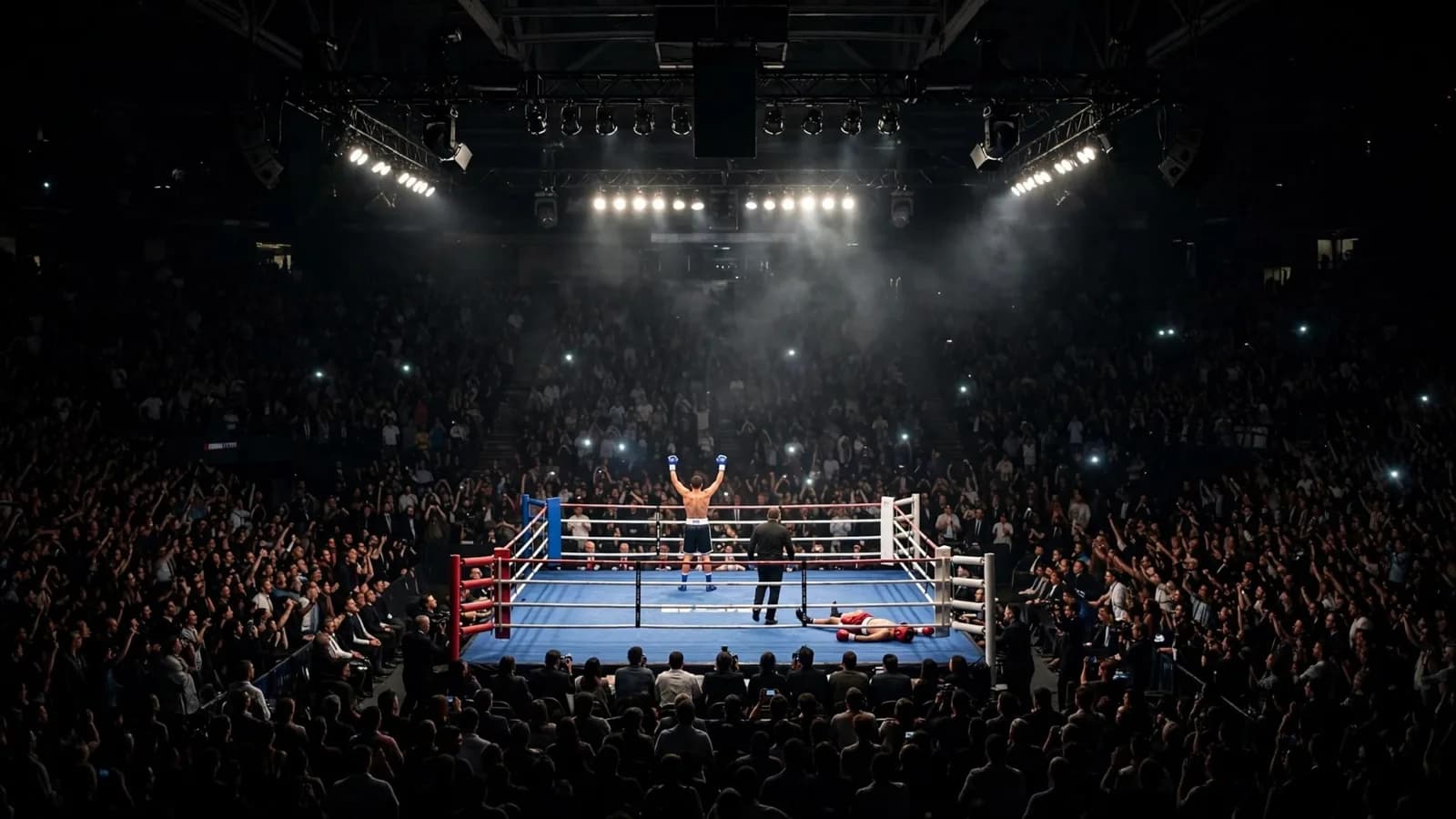
1. Buster Douglas knocks out Mike Tyson — 11 February 1990, Tokyo (42–1). The greatest upset in boxing history is not close. Mike Tyson arrived at the Tokyo Dome as the undefeated, undisputed heavyweight champion, 37–0 with 33 knockouts, the number one pound-for-pound fighter in the world. James "Buster" Douglas was 29–4–1 with 19 knockouts, ranked seventh, and the odds against him were 42–1 — so long that only the Mirage in Las Vegas would even take bets on the fight. Douglas had lost his mother, Lula Pearl, 23 days earlier, after she died of a stroke aged 46, and he had promised her he would beat Tyson. For nine rounds he boxed the fight of his life. Tyson dropped him with a right uppercut in the last ten seconds of round eight, but Douglas rose at nine — about thirteen seconds after going down, because the referee's count had started late — and the bell saved him. In round ten Douglas caught Tyson with a combination, and the champion went down for the first time in his career, fumbling for his mouthpiece as referee Octavio Meyran counted him out at 1:23. Don King protested the long count, the WBA and WBC briefly withheld recognition, and four days later Douglas was confirmed as champion. He lost the titles in his first defence to Evander Holyfield, knocked out in three rounds on 25 October 1990, weighing 246 lb, fifteen heavier than in Tokyo. It did not matter. Nobody who saw Tokyo ever forgot it.
“Because of my mother… God bless her heart.”
2. Corrie Sanders stops Wladimir Klitschko — 8 March 2003, Hanover (40–1). Wladimir Klitschko was 40–1 with 37 knockouts, aged 26, making the sixth defence of the WBO heavyweight title he had won from Chris Byrd in October 2000. Corrie Sanders was 38–2 with 28 knockouts, aged 37, a southpaw who had taken the fight at short notice at 40–1 and had fought only twice since losing to Hasim Rahman in May 2000. It lasted less than four minutes. Sanders floored Klitschko twice in the first round and twice more in the second, and referee Genaro Rodriguez stopped it 27 seconds into round two. The Ring named it the Upset of the Year for 2003. Sanders vacated the WBO belt that December to chase the WBC title, and Vitali Klitschko stopped him in eight rounds in Los Angeles on 24 April 2004. But for one night in Hanover, the 40–1 shot was the best heavyweight on the planet.
3. Andy Ruiz Jr stops Anthony Joshua — 1 June 2019, New York (25–1). Anthony Joshua came to Madison Square Garden for his American debut as the undefeated unified heavyweight champion, 22–0 with 21 knockouts, holding the WBA, IBF, WBO and IBO titles. His opponent was supposed to be Jarrell Miller, until Miller failed three drug tests and lost his New York licence. Andy Ruiz Jr, 32–1 with 21 knockouts, signed on 30 April, five weeks out, as a 25–1 underdog. In round three Joshua dropped Ruiz — the first time Ruiz had ever been down as a professional — and then Ruiz dropped Joshua twice in the same round. In round seven Ruiz dropped him twice more, and referee Michael Griffin waved it off at 1:27 after Joshua rose from the fourth knockdown, spat out his mouthpiece and turned away. Ruiz became the first heavyweight champion of Mexican descent. Joshua won the rematch on 7 December 2019 in Diriyah, Saudi Arabia, by unanimous decision, 118–110, 118–110 and 119–109. The first fight still stands as the night the heavyweight division turned upside down in seven rounds.
4. Evander Holyfield stops Mike Tyson — 9 November 1996, Las Vegas (opened 25–1). Six years after Douglas, Tyson was champion again, 45–1 with 39 knockouts, defending the WBA title he had won from Bruce Seldon two months earlier. Evander Holyfield was 32–3 with 23 knockouts, aged 34, and he opened as high as a 25–1 underdog, the price shortening to around 5–1 by fight time. The market had its reasons. Holyfield had lost his titles to Michael Moorer in April 1994, retired after a heart condition diagnosis that was later judged a misdiagnosis, and on his return had been knocked out by Riddick Bowe and looked unimpressive against Bobby Czyz. The Nevada commission required further examinations at the Mayo Clinic before it would sanction the fight. Holyfield floored Tyson with a left hook in round six, hurt him badly at the end of round ten, and referee Mitch Halpern stopped it 37 seconds into round eleven with Tyson upright on the ropes, unable to defend himself. An accidental clash of heads in round six had cut Tyson; Halpern ruled it accidental and deducted no points. The rematch, on 28 June 1997, ended in the third round when Tyson was disqualified for biting both of Holyfield's ears. The first fight needed no such ending. It was a masterclass.
5. Hasim Rahman knocks out Lennox Lewis — 22 April 2001, Brakpan (20–1). Lennox Lewis was 38–1–1 with 29 knockouts, defending the WBC, IBF and IBO heavyweight titles at Carnival City in Brakpan, South Africa, against Hasim Rahman, 34–2 with 28 knockouts, a 20–1 underdog. Brakpan sits 5,200 feet above sea level. Rahman had arrived on 27 March to acclimatise; Lewis did not arrive until 10 April, having trained in Las Vegas while filming a cameo in Ocean's Eleven. Lewis was ahead 39–37 on all three cards after four rounds. In round five Rahman landed a right hand to the jaw, and Lewis could not beat the count — knocked out at 2:32, referee Daniel Van de Wiele waving it off. The Ring named it the Upset of the Year and the Knockout of the Year for 2001. Lewis won the rematch on 17 November 2001 at Mandalay Bay in Las Vegas, knocking Rahman out in round four and taking his titles back. But for seven months, the man from Baltimore who had trained at altitude was the heavyweight champion of the world.
6. Leon Spinks beats Muhammad Ali — 15 February 1978, Las Vegas (10–1). Muhammad Ali was 55–2 with 37 knockouts, aged 36, defending the WBA, WBC and Ring undisputed heavyweight championship at the Las Vegas Hilton. Leon Spinks was 6–0–1 with five knockouts, aged 24, with seven professional contests behind him, and a 10–1 underdog. Over fifteen rounds Spinks outworked the champion and won a split decision, 145–140 and 144–141 for Spinks, 142–143 for Ali. He won the heavyweight title in his eighth professional contest, the fewest fights ever to a world heavyweight championship. Spinks was stripped of the WBC belt a month later for not facing Ken Norton, so the rematch, on 15 September 1978 at the Superdome in New Orleans, was for the WBA and Ring titles only. Ali won it by unanimous decision over fifteen rounds and became the first man to win the world heavyweight championship three times. Spinks had seven months as champion. It was enough to make him immortal.
7. Cassius Clay beats Sonny Liston — 25 February 1964, Miami Beach (7–1). Sonny Liston was the most feared man in boxing, a former convict who had learned to box in prison and won the heavyweight title with a first-round knockout of Floyd Patterson in September 1962, then repeated it in July 1963. Cassius Clay was 19–0 with 15 knockouts, aged 22, a 7–1 underdog, and 43 of the 46 ringside writers picked Liston. At the end of round four Clay came back to his corner saying his eyes were burning and he could not see, demanding his gloves be cut off. His trainer Angelo Dundee washed his eyes with a sponge and sent him out for round five with orders to run; his sight cleared by round six. Liston, citing a torn left shoulder, retired on his stool at the end of round six, and Clay was the new champion. The scorecards were level at the stoppage. The rematch, on 25 May 1965 in Lewiston, Maine, lasted one round: Ali won by first-round knockout, the famous "phantom punch". Clay became Muhammad Ali, and the loudest mouth in sport became its biggest star.
8. Muhammad Ali knocks out George Foreman — 30 October 1974, Kinshasa (4–1). Ten years after Liston, Ali was the underdog again, this time at 4–1. George Foreman was 40–0 with 37 knockouts, aged 25, defending the WBA, WBC and Ring titles, and he had destroyed Joe Frazier in two rounds — dropping him six times — and Ken Norton in two rounds, the two men who had beaten Ali. The fight, in the 20th of May Stadium in Kinshasa, Zaire, started at around four in the morning local time to suit American television, in front of 60,000 people. It had been postponed five weeks after Foreman was cut above the eye in sparring. From round two Ali leaned on the ropes and covered up, letting Foreman punch his arms and body until the champion tired — the tactic Ali later called the "rope-a-dope". In round eight Ali landed a five-punch combination ending with a left hook and a hard right, Foreman fell, rose to one knee, and referee Zack Clayton waved it off at 2:58. Ali was ahead on all three cards. At 32, he became only the second man after Floyd Patterson to regain the world heavyweight championship. The shortest odds on this list, and the most famous night in boxing history.
That is what the eight nights share. None of the eight winners was a better fighter than the man he beat, on paper. Each one was hungrier, or simply better prepared on the night, and each one walked into the ring knowing the whole sport had already written him off. The odds are a guess, made by people who have never taken a punch. The bell is the truth. That is why boxing never runs out of upsets, and why nobody who loves the sport will ever stop watching for the next one.