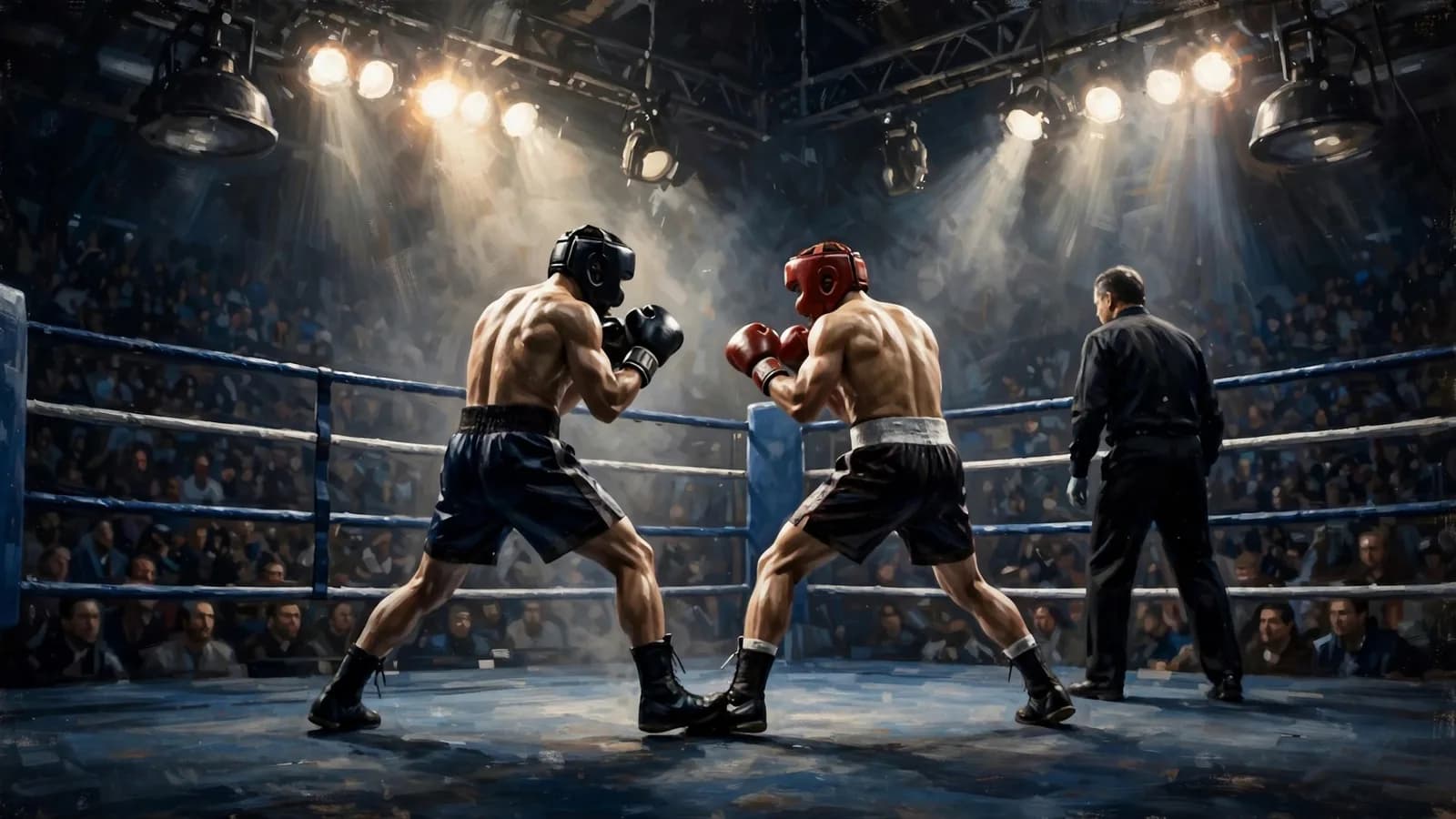
Boxing has a saying older than any belt: styles make fights. No pairing proves it better than southpaw against orthodox. Put two orthodox fighters together and they share a mirror — same lead foot, same angles, same habits learned in the same gyms. Put a southpaw in front of an orthodox fighter and the mirror cracks. The feet are on the wrong side. The jabs collide. The power hand comes from the direction nobody trained for.
“I think that I am the best switch-hitter ever.”
About one in ten people is left-handed. Among leading professionals the southpaw share is far higher — one analysis of the top 340 active male professionals found a quarter fought southpaw. The stance has built some of the greatest fighters who ever lived: Pacquiao, Hagler, Whitaker, Calzaghe, Lomachenko, Usyk. It has also been solved, brutally, by the orthodox fighters who did their homework. This is why the puzzle endures — and how it gets solved.
Two stances, one mirror
An orthodox boxer leads with the left foot and left hand. A southpaw leads with the right foot and right hand, the left hand held back as the power hand. The jab comes from the lead hand; the cross comes from the rear. The rule of thumb is to put your dominant hand at the rear — right-handed fighters stand orthodox, left-handed fighters stand southpaw — but handedness is a starting point, not the definition. A right-hander standing right-side forward is still a southpaw.
Stance is not guard. Stance is where your feet and body are; guard is where you hold your hands — near cheek level, lead hand slightly forward, elbows tucked, chin down. Two fighters can share a stance and carry entirely different guards. The stance decides the geometry. Everything else is built on top of it.
When a southpaw meets an orthodox fighter, the matchup is called open stance: both lead feet sit on the same side of the centre line. That single fact changes the whole fight. Both rear hands have a straighter route to the target — if the angle is won. The whole contest becomes a fight over inches of floor.
Why the southpaw is a problem
The first battle is the lead foot. Whichever fighter gets his lead foot outside the other's controls the angle. For the southpaw, right foot outside the orthodox fighter's left foot opens a clear lane for the straight left — his signature weapon, fired straight through the gap between the opponent's lead shoulder and rear hand — and takes away the orthodox fighter's rear cross. Get the foot outside and your left shoulder and rear hand line up with the target; your opponent's right hand has to travel across your lead side or reset before it can land clean.
The second weapon is the one orthodox fighters never see coming: the lead right hook. Orthodox fighters spend their lives watching for left-hand power. The right hook curves around the guard and can land clean before they register the threat.
The third problem is traffic. In open stance the lead hands meet constantly — right hand against left hand, deflecting each other — and the jab, boxing's most basic tool, gets less effective for both men. And the danger cuts both ways: the open stance gives the orthodox fighter's right cross a direct path to the southpaw's chin, just as the southpaw's left cross threatens the orthodox fighter. Drift inside instead of outside and the southpaw walks straight into the rear right hand.
Then there is the problem no gym can fully fix: unfamiliarity. Most people are right-handed, so most beginners learn orthodox, most padwork is taught orthodox first, and most sparring rounds are against orthodox partners. A southpaw spends most of his rounds seeing orthodox fighters. The orthodox fighter gets far fewer rounds against someone like him. Trainers call it the southpaw advantage — the familiarity gap.
The research, honestly, is split on whether the advantage shows up in the win column. One study of professional boxers found no effect of a fighter's own stance on his win ratio. A study of mixed martial artists found no significant relationship between laterality and winning percentage. What nobody disputes is the familiarity gap itself — and every great southpaw on this list built a career on opponents who had spent their lives preparing for someone else.
The great southpaws
Manny Pacquiao — 62-8-3 with 39 knockouts, the only boxer to win world championships in eight weight divisions. The southpaw left hand did the damage at every weight he touched. On 6 December 2008 he stopped Oscar De La Hoya at the end of the eighth round — De La Hoya's corner pulled him out, and he never fought again — and on 14 November 2009 he stopped Miguel Cotto in the twelfth to win the WBO welterweight title. Fighting southpaw, he reached De La Hoya through the centre with straight lefts while the bigger man struggled to judge the distance.
Marvin Hagler — 62-3-2 with 52 knockouts, undisputed middleweight champion from 1980 to 1987 with twelve title defences. He won the title stopping Alan Minter in three rounds in London in 1980, outpointed Roberto Durán over fifteen rounds in 1983, and then, on 15 April 1985 at Caesars Palace, stopped Thomas Hearns in the third round of "The War" — the fight that still defines the middleweight division. Hearns broke his right hand in the first round. Hagler was a southpaw who switched stances with ease, and in the second round against Hearns he briefly tried orthodox before switching back to southpaw, where he found more success countering Hearns' jab.
Pernell Whitaker — 40-4-1 with 17 knockouts, a four-weight world champion and the undisputed lightweight champion, with six defences — the longest unified lightweight championship reign in boxing history. He unified the division by knocking out Juan Nazario in the first round on 11 August 1990. Three years later, against Julio César Chávez, he gave the definitive southpaw performance: moving to his right, keeping his lead foot outside Chávez's left, interrupting the challenger with a quick right jab. Chávez, 87-0 coming in, could not land consistently. The judges called it a majority draw. Every press card had Whitaker winning.
Joe Calzaghe — 46-0 with 32 knockouts, unbeaten across his whole career. He held the WBO super middleweight title from 1997 to 2007 with 21 successful defences, a division record. On 4 March 2006 he took the unbeaten Jeff Lacy apart over twelve rounds — 119-105, 119-107 twice, outlanding him 351 punches to 116 — and the following year he outpointed the unbeaten Mikkel Kessler in Cardiff before 50,000 people. He closed his career at light heavyweight, beating Bernard Hopkins and Roy Jones Jr.
Vasiliy Lomachenko — 18-3 with 12 knockouts, a three-weight world champion and the fastest fighter ever to win titles in three divisions, in just twelve professional fights. He won his first world title in only his third pro fight, a majority decision over Gary Russell Jr. in June 2014, and took the lightweight crown by stopping Jorge Linares in the tenth round at Madison Square Garden in May 2018.
Oleksandr Usyk — the modern standard-bearer. A southpaw who is right-handed but fights with his left hand back. He beat Anthony Joshua in September 2021 to win the WBA, IBF and WBO heavyweight titles, then beat Tyson Fury in May 2024 to become the first undisputed heavyweight champion of the four-belt era — the first since Lennox Lewis — and beat him again that December. In July 2025 he knocked out Daniel Dubois in the fifth round to become the first man to be a three-time undisputed champion in the four-belt era.
The orthodox answers
The stance can be solved. Floyd Mayweather did it to Pacquiao himself. On 2 May 2015, Mayweather — orthodox — beat Pacquiao by unanimous decision, 118-110 and 116-112 twice, establishing distance with his jab and countering the charging southpaw with stinging right hands, keeping him on the outside. Pacquiao landed 81 of 429 punches. Mayweather went to 48-0.
Teofimo Lopez did it to Lomachenko. On 17 October 2020, Lopez built an early lead by keeping Lomachenko on the back foot and turning with him, so the Ukrainian could not use his angles. Lopez controlled the lead hand — and once a southpaw loses his lead hand, he loses his exits. Lomachenko landed just 31 punches in the first seven rounds. Lopez won a unanimous decision, 116-112, 117-111 and 119-109, and took Lomachenko's titles.
Even the fights the southpaw won show the orthodox answer working in stretches. Fury, orthodox, used feints and a long jab against Usyk in their first fight in May 2024, following up with a stinging right uppercut — and then Usyk found a home for his overhand left, floored Fury in the ninth, swept rounds eight to ten on all three cards and took a split decision. In the rematch that December, Usyk's left hand staggered Fury twice in the sixth, and he won 116-112 on all three cards. The orthodox tools were all there. Usyk was better anyway.
And sometimes the answer is that there is no answer. Chávez could not solve Whitaker at all — the draw flattered the unbeaten champion, not the challenger. The southpaw puzzle does not always have a solution on the night.
How you beat a southpaw
Ask trainers and the first answer is always the same: spar southpaws. Sparring with southpaw partners during camp is the best preparation, because the angles feel unfamiliar until they are practised. The second answer is foot position. The orthodox fighter's right foot steps to the outside of the southpaw's left foot — that takes him off the line of the straight left and opens a clear right-cross angle. Do not throw a jab until the right foot is already outside; a jab thrown from the inside opens the chin to the left straight counter.
Then come the punches built for the matchup. The overhand right, thrown over the southpaw's jab and arcing into the temple, punishes a southpaw who jabs heavily without slipping. The jab to the body, dropped from a lower slot so the parry misses, sets up the right hand behind it. Miguel Cotto showed how it works against Sergio Martinez in June 2014: he stepped to the inside of Martinez's right foot and drove a jab to the body that landed clean on the ribs in the first round — the start of a footwork clinic.
Even the textbooks disagree on one point: which way to circle. Some coaches say circle left, away from the southpaw's power hand. Others say circling left walks straight into the left hand, and circle right instead. The disagreement itself is the lesson — there is no single orthodox answer, only principles, drilled until they hold under fire.
The switch-hitters
The final twist is the fighter who refuses to pick a side. Terence Crawford, 42-0 with 31 knockouts, switches stances between punches — setting up shots standing orthodox, then landing heavy as a southpaw, and back again. "I think that I am the best switch-hitter ever," he says. The record backs the claim: on 29 July 2023 he stopped Errol Spence in the ninth round to win the undisputed welterweight crown, flooring him in the second and twice in the seventh, outlanding him 185 punches to 96; on 13 September 2025 he outpointed Canelo Álvarez over twelve rounds to win the super middleweight titles. Across his career he has won 18 major world championships in five weight classes.
He is not alone. Jaron "Boots" Ennis, a natural orthodox fighter, has built his reputation switching to southpaw — he can knock you out from either side. Tyson Fury, naturally orthodox, has switched to southpaw to surprise opponents, including in his wins over Dillian Whyte and Derek Chisora. Hagler did it more than forty years ago. The switch-hitter takes the southpaw's advantage — unfamiliarity — and doubles it: the opponent cannot even settle on which puzzle he is solving.
The puzzle endures
A century into the sport, the southpaw is still the question every orthodox fighter has to answer, and still the stance that produces the fighters nobody wants to face. The geometry is simple: a lead foot, a straight left, a hook from the blind side. The solution is simple too: get your foot outside, keep your right hand ready, spar the stance until it stops feeling strange. Simple — and, as Pacquiao, Hagler, Whitaker, Calzaghe, Lomachenko and Usyk all proved, never easy. That gap between simple and easy is where styles make fights.