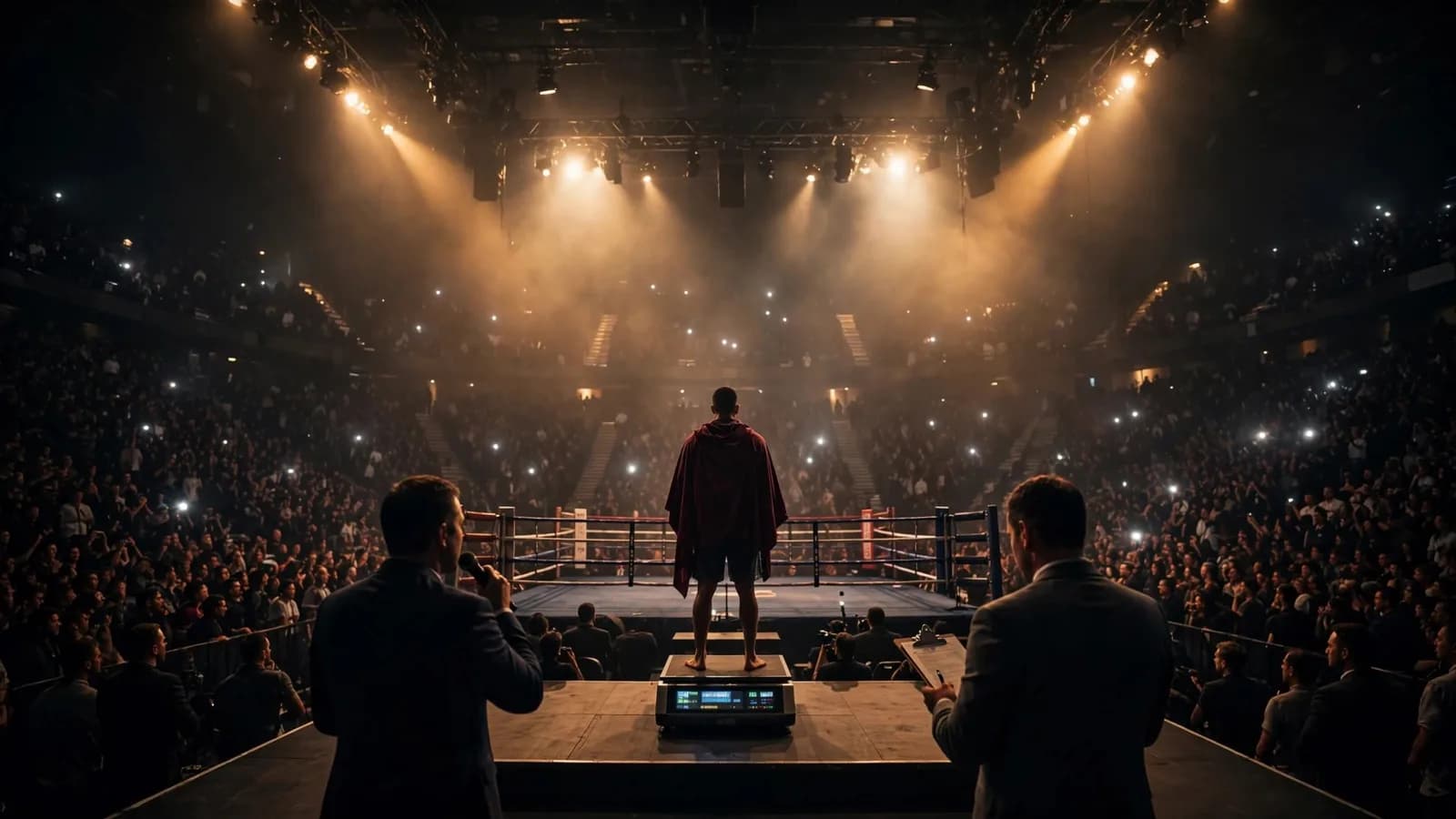
Every fight in boxing starts before the first bell, on a scale in a back room. Two men step on, a number is read out, and that number decides whether the fight happens at all. The scale is the first opponent every boxer has to beat, and it is the only one that never loses. The divisions below are the whole sport, from the smallest men who fight at 105 pounds to the heavyweights, who have no ceiling at all.
“The scale is the first opponent every boxer has to beat.”
The seventeen divisions. The four major sanctioning bodies — the WBA, WBC, IBF and WBO — share the same limits for men, from 105 lb to 200 lb, though they do not always share the names: the IBF and WBO call most of the "super" divisions "junior", so super featherweight is junior lightweight to them — super middleweight is the exception, keeping its name in all four bodies — and the WBO calls cruiserweight junior heavyweight. The lightest men: minimumweight, also called strawweight, up to 105 lb (47.6 kg); light flyweight, 108 lb (49.0 kg); flyweight, 112 lb (50.8 kg); super flyweight, 115 lb (52.2 kg); bantamweight, 118 lb (53.5 kg); super bantamweight, 122 lb (55.3 kg). The middle of the sport: featherweight, 126 lb (57.2 kg); super featherweight, 130 lb (59.0 kg); lightweight, 135 lb (61.2 kg); super lightweight, 140 lb (63.5 kg); welterweight, 147 lb (66.7 kg); super welterweight, 154 lb (69.9 kg). And the big men: middleweight, 160 lb (72.6 kg); super middleweight, 168 lb (76.2 kg); light heavyweight, 175 lb (79.4 kg); cruiserweight, 200 lb (90.7 kg); heavyweight, over 200 lb, with no upper limit. The gaps are small at the bottom — three pounds between some divisions — and wide at the top, because three pounds matters far more to a 105-pound man than to a 200-pound one. One exception sits above cruiserweight: the WBC's bridgerweight division, 200 to 224 lb, which means that under the WBC a heavyweight starts over 224 lb rather than over 200 lb.
How we got here. Boxing did not always have weight classes. Under Broughton's Rules in 1738 there was only a crude split, at 160 lb: heavier weights above it, lighter weights below. The Marquess of Queensberry Rules, published in 1867, said nothing about weight at all — none of the twelve rules mentions divisions or weigh-ins. The London Prize Ring Rules named featherweight at 118 lb and bantamweight at 105 lb in 1860, and the first champions followed one division at a time: Nonpareil Jack Dempsey became the first modern middleweight champion in 1884; Jack McAuliffe claimed the first lightweight title in 1886, a claim that was disputed; Paddy Duffy won the first welterweight title in 1889, when the limit was 145 lb; Ike Weir won the first featherweight title in 1890; Jack Root won the first light-heavyweight title in 1903; Sid Smith won the first flyweight title in 1911. The eight traditional divisions — heavyweight, light heavyweight, middleweight, welterweight, lightweight, featherweight, bantamweight and flyweight — were formalised by London's National Sporting Club in 1909 and 1910. New York's Walker Law of 1920 standardised those eight in the United States and sketched the "tweener" divisions on paper, at 108, 115, 122, 130, 140 and 154 lb, but most of them sat dormant for decades. They arrived one by one: junior lightweight crowned its first champion, Johnny Dundee, in 1921; junior welterweight followed with Pinky Mitchell in 1922; both were revived in 1959. Junior middleweight was recognised in 1962, when Emile Griffith beat Ted Wright in Vienna. Light flyweight was reintroduced in 1975, super bantamweight in 1976, super flyweight in 1980, and super middleweight in 1984, when Murray Sutherland beat Ernie Singletary for the IBF title. Strawweight, the lightest division at 105 lb, arrived last, in 1987, when Lee Kyung-yun knocked out Masaharu Kawakami for the IBF title. Cruiserweight was created in 1979 to give smaller heavyweights somewhere to fight: Marvin Camel beat Mate Parlov in March 1980 to become the first champion, at a limit of 190 lb that was later raised to 200 lb. The newest division, bridgerweight, was announced by the WBC in November 2020 for fighters between 200 and 224 lb, named after six-year-old Bridger Walker; Oscar Rivas beat Ryan Rozicki in October 2021 to win the first title. The WBA adopted bridgerweight in December 2023 and discontinued it on 30 June 2026, leaving it a WBC division.
The great weight-jumpers. The divisions are not cages. The greatest fighters in history treated them as doors. Bob Fitzsimmons was the first to hold world titles in three divisions: middleweight in 1891, heavyweight in 1897, when he knocked out Gentleman Jim Corbett, and light heavyweight in 1903. Henry Armstrong went further. In 1938 he became the only boxer ever to hold three world titles at the same time, winning the featherweight title in October 1937, the welterweight title from Barney Ross in May 1938 and the lightweight title from Lou Ambers in August 1938. Thomas Hearns became the first man to win world titles in four divisions in 1987, and went on to win in five. Sugar Ray Leonard won titles in five divisions, Oscar De La Hoya in six, and Manny Pacquiao in eight — flyweight in 1998, super bantamweight in 2001, featherweight in 2003, super featherweight and lightweight in 2008, light welterweight and welterweight in 2009, and light middleweight in 2010, when he beat Antonio Margarito at a 150 lb catchweight weighing only 144.6 lb himself. Roy Jones Jr made the most audacious jump of the modern era: on 1 March 2003 he weighed 193 lb and beat John Ruiz, who weighed 226 lb, for the WBA heavyweight title — the first former middleweight champion in 106 years to win a heavyweight title, since Fitzsimmons in 1897. Canelo Alvarez has won world titles in four divisions, from light middleweight to light heavyweight, and became the first undisputed super-middleweight champion when he beat Caleb Plant in November 2021. Oleksandr Usyk unified the cruiserweight division in 2018, moved up to heavyweight in 2019 and became the undisputed heavyweight champion in 2024, following the path Evander Holyfield took when he unified cruiserweight and moved up in 1988.
The weigh-in game. The number on the scale is a negotiation, and fighters have spent a century learning to game it. Fights used to be weighed on the day of the fight. Nevada moved weigh-ins to the day before in the mid-1980s, after ringside physician Dr Flip Homansky argued that dehydrated fighters had too little time to rehydrate before the bell — dehydration reduces the cerebrospinal fluid that cushions the brain. The change had an unintended consequence: fighters now cut harder, knowing they have a day to put the weight back on. Arturo Gatti gained 19 lb after the weigh-in for his fight with Joey Gamache in 2000; Gamache was sent to hospital and his career ended. The sanctioning bodies have tried to close the gap. The IBF holds a second weigh-in on the morning of the fight: under its rules a boxer may not weigh more than 10 lb over the division limit, and from 2021 the ceiling slides by division, from 10 lb in the lightest divisions to 14 lb at cruiserweight. Unification bouts have been exempt since August 2017. Daniel Jacobs skipped the second check before his fight with Gennady Golovkin in March 2017, before the exemption existed, and forfeited his chance at the IBF title. The WBC runs check weights in camp — no more than 10 percent over the limit 30 days out, 5 percent at 14 days, 3 percent at 7 days — and a fight-day weigh-in of no more than 10 percent above the official weight. When two fighters cannot agree on a division, they agree on a catchweight: a negotiated limit between divisions. Manny Pacquiao and Miguel Cotto fought at 145 lb for the WBO welterweight title in November 2009, two pounds under the 147 lb limit. Floyd Mayweather and Juan Manuel Marquez agreed on 144 lb in September 2009; Mayweather weighed 146 lb and paid Marquez 600,000 dollars, 300,000 for each pound over. Canelo Alvarez and Julio Cesar Chavez Jr fought at 164.5 lb in May 2017, with a million dollars per pound in penalties for missing it. The scale can also take a title away. Gervonta Davis weighed 132 lb for a 130 lb limit in August 2017 and was stripped of his IBF super-featherweight title on the scales; he won the fight, but the title stayed vacant. Diego Corrales weighed 139.5 lb for a 135 lb limit in October 2006, was fined 240,000 dollars and lost his lightweight title on the scales before losing the fight. The danger is real. In August 2025 two Japanese fighters, Hiromasa Urakawa and Shigetoshi Kotari, died after separate bouts in Tokyo, and the World Boxing Association said dehydration from fast weight cutting was seen as a factor in making the brain more susceptible to bleeding; the Japan Boxing Commission introduced urine tests to measure dehydration and stricter rules on weight loss.
The women's divisions. Women box in seventeen divisions too, with the same limits as the men from 105 lb to 175 lb, and two differences: the lightest women's division is atomweight, at 102 lb, and there is no cruiserweight — women's light heavyweight at 175 lb goes straight to heavyweight, which has no upper limit.
That is what the divisions are for. They do not make boxing fair — nothing can, when one man is born six inches taller and thirty pounds heavier than another. They make it possible. A 105-pound strawweight and a 200-pound cruiserweight will never meet, and that is the point: each of them fights men his own size, and the only thing left to decide is who is better. The scale is the first opponent every boxer has to beat. The great ones beat it, then beat everyone else too.