The basics: eleven against eleven
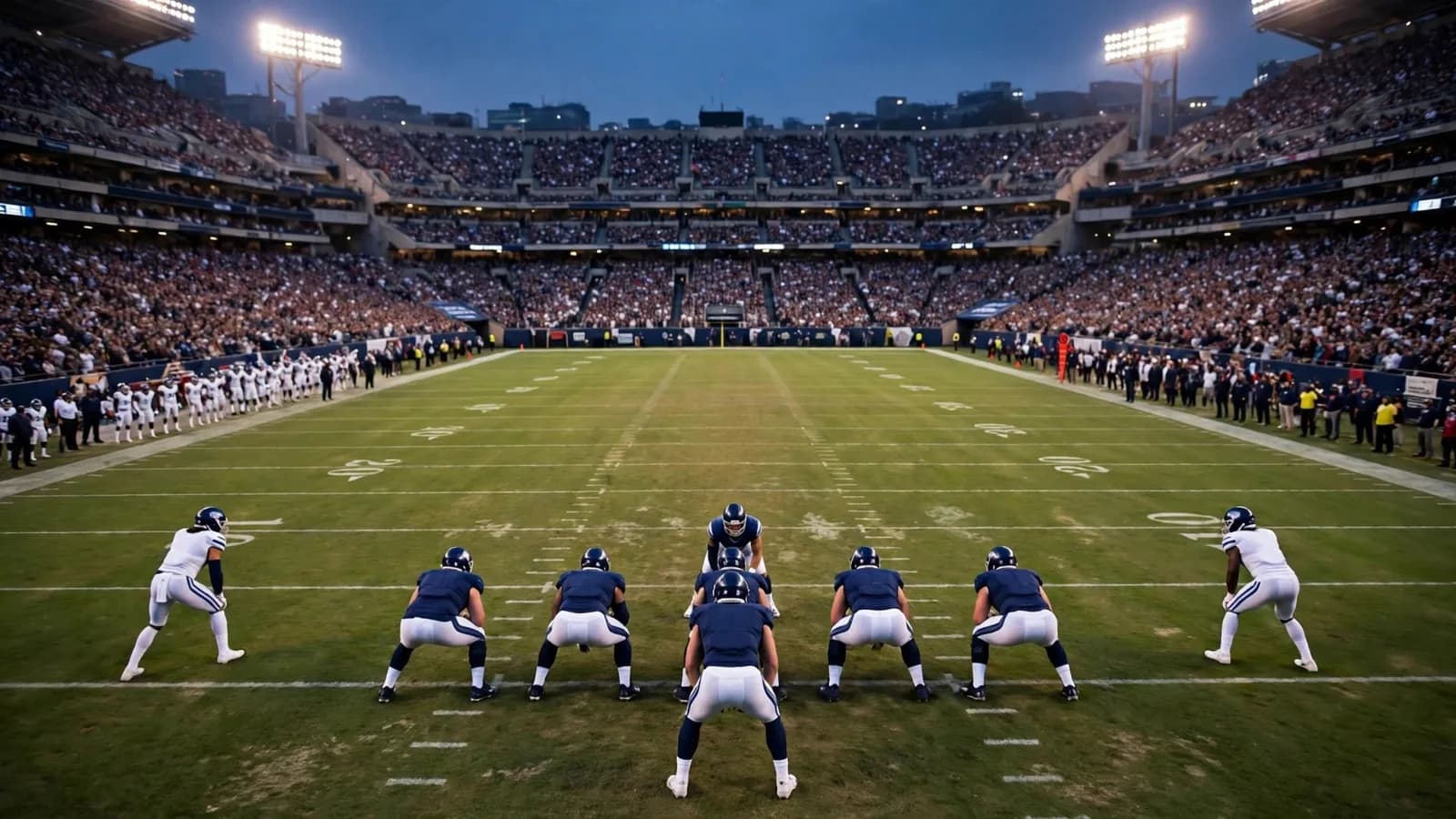
Each team puts eleven players on the field at a time, and the two sides swap whole units depending on who has the ball. The team with the ball sends out its offense; the other team sends out its defense. A third unit, special teams, handles kicks and punts. Behind those eleven, each NFL squad carries a 53-man roster, with up to 48 players dressed for a game.
The field is 100 yards long between the goal lines, with a 10-yard end zone at each end. The offense gets four attempts, called downs, to move the ball at least 10 yards. Gain those 10 yards and the count resets to first down; fail, and the other team takes over. A touchdown is worth 6 points, a field goal 3, an extra-point kick after a touchdown 1, and a safety, when the defense tackles the ball carrier in his own end zone, 2.
That is the whole framework. Now here is who does what inside it.
Offense: the quarterback runs the show
The quarterback is the leader of the offense and the only player who touches the ball on almost every offensive play. He takes the snap from the center, then hands the ball to a runner, throws it to a receiver, or keeps it and runs himself. Before the snap he reads the defense and calls adjustments, then decides in a split second where the ball should go. The most famous current example is Josh Allen of the Buffalo Bills, the starting quarterback on the Bills' 2026 depth chart and the player the whole Buffalo offense is built around.
Behind the quarterback stands the running back, whose main job is to take handoffs and run through the gaps the line opens up. A good running back also catches short passes and blocks for the quarterback. Saquon Barkley of the Philadelphia Eagles is the classic example: a lead back who breaks tackles and turns a routine handoff into a long gain.
The fullback is the running back's bodyguard. He lines up in front of the ball carrier, clears a path by blocking the first defender he meets, and occasionally carries the ball himself on short-yardage plays or slips out for a surprise catch. Most teams no longer carry a fullback at all. Kyle Juszczyk of the San Francisco 49ers is the best-known fullback in the league, a veteran who blocks, catches and runs in the 49ers' offense.
Offense: the pass catchers
The wide receivers are the speed merchants. They line up split out wide, run precise routes to get open, and catch the ball in space. On a typical play, two or three receivers spread the defense out, forcing cornerbacks and safeties to cover the whole width of the field. Ja'Marr Chase of the Cincinnati Bengals is the archetype: the Bengals' top receiver and a player who can turn a short catch into a long touchdown.
The tight end is the offense's hybrid. He lines up next to the offensive tackle, blocks like a lineman on running plays, and runs routes like a receiver on passing plays. That double duty makes him a mismatch: too big for a cornerback to cover, too fast for a linebacker. Travis Kelce of the Kansas City Chiefs is the defining tight end of his era, the Chiefs' first-choice target in the middle of the field.
Offense: the line that makes it all work
The offensive line is five players, and none of them touches the ball. Their job is protection and road-building: keep defenders away from the quarterback, and open running lanes. From the quarterback's left to right they are the left tackle, left guard, center, right guard and right tackle.
The center starts every play by snapping the ball to the quarterback, then blocks the defender in front of him and calls out the assignments. Creed Humphrey of the Kansas City Chiefs is the standard at the position, the Chiefs' starting center.
The guards stand either side of the center. They block in tight spaces, pull across the formation to lead running plays, and help the center against the biggest interior defenders. The tackles stand on the edges of the line. The left tackle is usually the most prized of the five, because he protects the blind side of a right-handed quarterback. Trent Williams of the San Francisco 49ers is the reference point: the 49ers' starting left tackle, a veteran who has held the job for years and sets the standard for the position.
If the quarterback has time to throw, the line did its job. If the running back finds a hole, the line made it.
Defense: the line up front
The defensive line stands opposite the offensive line, and its job is disruption: stop the run, collapse the pocket and get to the quarterback. In a four-man front there are two defensive ends on the edges and two defensive tackles inside.
The defensive ends line up wide, rush the passer from the outside, and set the edge against the run so ball carriers cannot escape around the corner. Nick Bosa of the San Francisco 49ers is the model: a 49ers defensive end who wins with speed and power off the edge.
The defensive tackles line up inside, over the guards and center. They plug the middle against the run and push the pocket from the inside, the shortest route to the quarterback. Chris Jones of the Kansas City Chiefs is the leading example, the Chiefs' starting defensive tackle.
In a three-man front, the middle lineman is called the nose tackle, because he lines up nose-to-nose with the center. He takes on two blockers at once so the linebackers behind him can run free.
Defense: the linebackers
The linebackers stand behind the defensive line, and they are the defense's all-rounders: part run-stopper, part pass-rusher, part coverage defender. The middle linebacker, often called the Mike, is the quarterback of the defense. He calls the plays, lines everyone up, and fills the gaps against the run. Fred Warner of the San Francisco 49ers is the best example in the game, the 49ers' middle linebacker.
The outside linebackers play wider, covering tight ends and running backs, setting the edge, and rushing the passer. In some defenses the edge rusher is a specialist of his own, a player whose first job is to beat the tackle and sack the quarterback. Myles Garrett is that specialist: traded from the Cleveland Browns to the Los Angeles Rams on June 1, 2026, he now rushes the passer for the Rams, and he arrived there as the league's single-season sack record holder.
Defense: the secondary
The secondary is the last line of defense, and its job is to stop the pass. The cornerbacks cover the wide receivers one-on-one, mirroring their routes down the field and trying to break up or intercept the ball. Sauce Gardner of the Indianapolis Colts is the name to know, a cornerback traded from the New York Jets to the Colts who shadows the opponent's best receiver.
The safeties play deeper, reading the quarterback's eyes and covering the ground the cornerbacks cannot. The strong safety lines up closer to the line, helps against the run and covers tight ends; the free safety plays further back as the last defender, ranging across the field to stop deep passes. Kyle Hamilton of the Baltimore Ravens is the versatile starting safety/DB in that picture. Malaki Starks, his Ravens teammate, is the free safety, the deep defender behind him.
When the offense sends out three or more receivers, the defense answers with a fifth defensive back, the nickel cornerback. He replaces a linebacker and covers the slot receiver, and has to be quick enough to cover and tough enough to tackle in the run game.
Special teams: the third phase
Special teams decide field position, and field position decides games. The kicker scores the points: field goals through the uprights and extra points after touchdowns. Brandon Aubrey of the Dallas Cowboys is the current example, the Cowboys' kicker and one of the league's most reliable long-range legs.
The punter kicks the ball away on fourth down, when the offense cannot reach the first-down line and is too far out to try a field goal. A good punt flips the field, pinning the other team deep in its own half. Bryan Anger of the Dallas Cowboys handles that job.
The long snapper is the most invisible player on the field, and the most specialised. He snaps the ball accurately over a long distance on punts, field goals and extra points, and a bad snap can ruin a kick before it starts. Trent Sieg of the Dallas Cowboys holds that role.
The returner catches the kicks and punts and runs them back, turning a defensive moment into an attacking one. KaVontae Turpin of the Dallas Cowboys is the return specialist there, the Cowboys' kick and punt returner. Around him, the coverage team sprints downfield to tackle him, and the blocking team tries to open a lane.