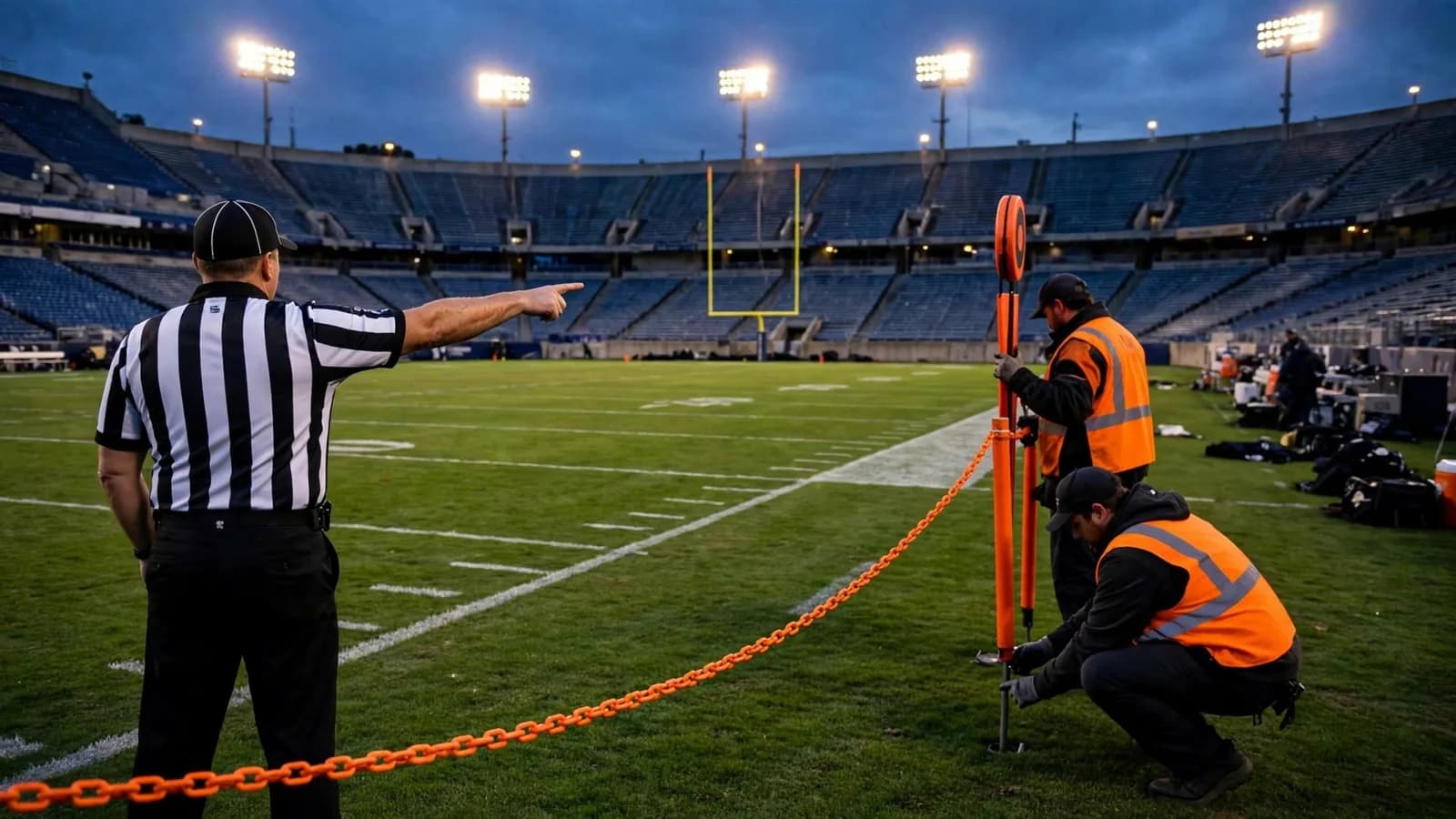
The field
“Start with the down and distance, then the score, then the clock.”
An NFL game is played by two teams of 11 players each on a field that is 100 yards long between the goal lines, with a 10-yard end zone at each end, making 120 yards in total, and 53 1/3 yards wide. Yard lines cross the field every five yards and are numbered every 10 yards, counting up to the 50-yard line in the middle and back down toward the other goal line. Two rows of hash marks run down the middle of the field, 18 feet 6 inches apart in the NFL, and every play starts with the ball placed on or between those marks. When the graphic says a team is at its own 25, the ball is 25 yards from its own goal line; at the opponent's 20, it is 20 yards from scoring.
The line of scrimmage
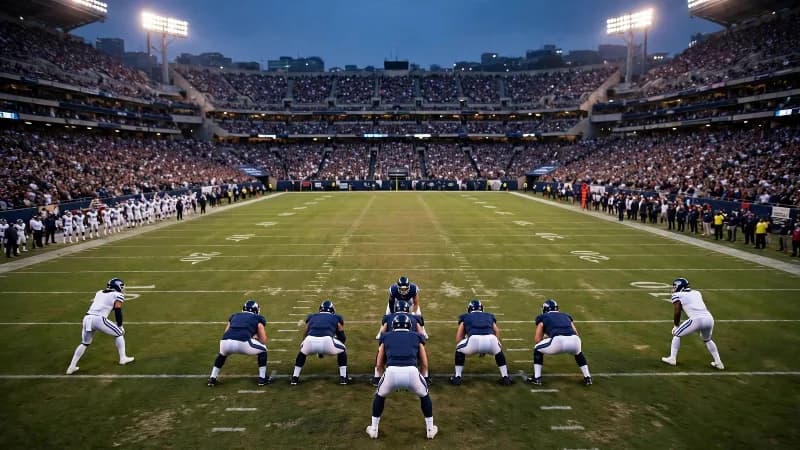
Every play starts at the line of scrimmage, an imaginary line running from sideline to sideline through the front tip of the ball. The offense lines up on one side of it and the defense on the other, and neither side may cross it until the ball is snapped. The snap is the moment the center hands or tosses the ball back to the quarterback. The space between the two teams at the line is the neutral zone, and a defender who enters it before the snap risks a penalty.
Downs and the first-down chain
The offense gets four downs, or attempts, to advance the ball 10 yards from where its series started. If it gains those 10 yards, it earns a first down and a fresh set of four downs. The graphic "1st and 10" means first down with 10 yards to go; "2nd and 7" means second down with seven yards to go. If the offense fails on fourth down, the other team takes over at the spot where the play ended, which is called a turnover on downs. That is why fourth down is a decision point: a team close to the opponent's end zone may try for a field goal, a team deep in its own territory usually punts, and a team in between may gamble and go for it.
How a play ends
A play ends when the ball carrier is tackled and down, runs out of bounds, scores, or when a pass falls incomplete. A runner is down when a knee, elbow or any body part other than a hand or foot touches the ground while a defender has contact with him. A fumble is a ball dropped or knocked loose before the runner is down, and either team can recover it. An interception is a pass caught by the defense, which then takes over on offense. A catch in the NFL requires control of the ball with both feet, or another body part, in bounds.
Scoring
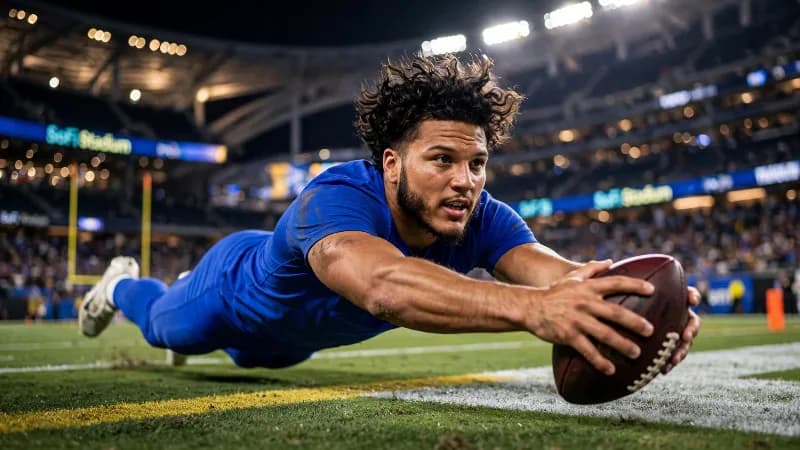
There are five ways to score, and only five. A touchdown is worth six points and is scored when a player carries the ball across the opponent's goal line or catches a pass in the end zone. After a touchdown, the scoring team gets one extra play, called the try. It can kick the ball through the goalposts for one point, with the ball snapped from the 15-yard line, or run one play from the two-yard line and reach the end zone again for a two-point conversion worth two points. A field goal is worth three points and is a kick through the goalposts during normal play, usually tried on fourth down when a team is close enough to score but unlikely to reach the end zone. A safety is worth two points to the defense and happens when the offense is tackled with the ball in its own end zone, or commits certain fouls there. A touchdown plus the kicked extra point is seven points; with a two-point conversion it is eight.
The clock
A game lasts 60 minutes, divided into four quarters of 15 minutes each, with halftime between the second and third quarters. The game clock does not run all the time: it stops for incomplete passes, when a player runs out of bounds, after scores, for penalties and when a team calls a timeout. Each team has three timeouts per half, and unused timeouts do not carry over. The play clock gives the offense 40 seconds from the end of the previous play to snap the ball, or 25 seconds after certain stoppages such as a penalty, an injury or a timeout. If the play clock hits zero before the snap, the offense is flagged for delay of game. The two-minute warning is an automatic stoppage when two minutes remain on the clock in the second and fourth quarters.
Kickoffs and punts
Games start, halves start and most scores are followed by a kickoff, with the ball kicked from the kicking team's own 35-yard line. The receiving team can catch the kick and run it back, or let it go into the end zone for a touchback, which gives the receiving team the ball without a return. Under the kickoff format introduced in 2024, most of the kicking team lines up at the receiving team's 40-yard line, and the ball must land in the landing zone between the goal line and the 20-yard line. A punt is a kick on fourth down, usually when a team is too far from the end zone to try a field goal and does not want to risk a turnover on downs. The other team catches it and runs it back as far as it can, and that is where its offense starts. A returner can also signal for a fair catch, waving an arm before catching the ball, which means the play ends where he catches it and he cannot be tackled. An onside kick is a short kickoff in which the kicking team tries to recover the ball itself, usually late in a game when it is behind. Since the 2026 rule change, a team may declare an onside kick at any time in the game, but it must declare it to the referee first — a surprise onside kick is no longer allowed.
Penalties: the yellow flags
When an official throws a yellow flag, a rule has been broken. The penalty is measured in yards against the offending team, and some defensive penalties also give the offense an automatic first down. A false start is five yards: an offensive player moves before the snap. Offside is also five yards: a defender crosses the line of scrimmage before the snap. Offensive holding is 10 yards: a blocker illegally grabs or restricts a defender. Defensive holding is five yards plus an automatic first down: a defender illegally grabs a receiver or another player who does not have the ball. Defensive pass interference is a spot foul plus an automatic first down: a defender illegally contacts a receiver while the pass is in the air, and the ball is placed where the foul happened. Offensive pass interference is 10 yards: a receiver pushes off or blocks a defender before the ball arrives. Roughing the passer is 15 yards plus an automatic first down: a defender hits the quarterback late or illegally after he has thrown. Unnecessary roughness and face mask fouls are also 15 yards. If a penalty is accepted, the down is usually replayed from the new spot, unless the foul itself carries an automatic first down.
Challenges and replay
Coaches can challenge a call by throwing a red flag, asking the officials to review the play on video. Each team has at least two challenges per game, and an unsuccessful challenge costs the team a timeout. A team that wins at least one of its first two challenges is awarded a third challenge. Scoring plays and turnovers are automatically reviewed by the replay official, so no challenge is needed for those. The standard for overturning a call is clear and obvious visual evidence: if the video does not clearly show the call was wrong, the call on the field stands.
Watching like a fan
Start with the down and distance, then the score, then the clock. On first down, a team can run or pass freely. On second and third down, the distance tells you how aggressive it needs to be. On fourth down, watch the decision: punt, field goal or go for it. When a flag flies, wait for the announcement — the yardage and the down often matter more than the foul itself.
Overtime
If a game is tied after four quarters, it goes to overtime. In the regular season, overtime is a single period of 10 minutes, and since the rule change approved in 2025, both teams are guaranteed a chance to possess the ball, just as they have been in the playoffs since 2022. A touchdown on the opening drive no longer ends the game before the other team touches the ball. The only exception is a safety scored by the kicking team on the receiving team's first possession, which ends the game at once. Once both teams have had a possession, the next score of any kind wins. If the score is still level when the 10 minutes run out, the game ends in a tie. In the playoffs, overtime periods last 15 minutes, both teams are again guaranteed a possession, and play continues for as many periods as it takes to produce a winner, because a playoff game cannot end in a tie.