On This Day — November 12: The Birthday
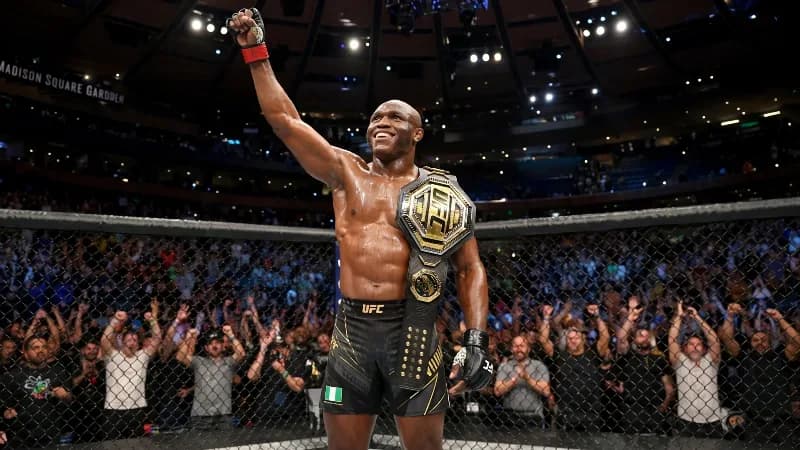
Every sport has a first day, and almost none of them get to keep celebrating it. November 12 is the exception. On this date in 1993, in Denver, eight men walked into a cage with almost no rules to answer a question television had never asked. Twenty-three years later, on the same date, the sport threw itself the loudest party in its history at Madison Square Garden. Six years after that, same building, same date, a kickboxer completed the most audacious heist the middleweight division has ever seen. November 12 is not a date on this calendar. It is the calendar's foundation, and its two loudest anniversaries.
Every sport has a first day, and almost none of them get to keep celebrating it. November 12 is the exception. On this date in 1993, in Denver, eight men walked into a cage with almost no rules to answer a question television had never asked. Twenty-three years later, on the same date, the sport threw itself the loudest party in its history at Madison Square Garden. Six years after that, same building, same date, a kickboxer completed the most audacious heist the middleweight division has ever seen. November 12 is not a date on this calendar. It is the calendar's foundation, and its two loudest anniversaries.
1993 — The Beginning
The Ultimate Fighting Championship was sold to the 7,800 people at the McNichols Sports Arena in Denver, and 86,000 more on pay-per-view, as a question: which fighting style actually wins? There were no weight classes, no rounds, no judges. A fight ended by submission, knockout, or a corner throwing in the towel. The rulebook, such as it was, banned biting and eye-gouging, and enforced the ban with a $1,500 fine. The winner of the eight-man tournament took $50,000 and, though nobody phrased it this way yet, the future.
The field was a carnival of specialists: a sumo wrestler, a boxer, kickboxers, a shoot-fighter named Ken Shamrock who looked like the answer to the question all by himself. And then there was Royce Gracie — the smallest man in the bracket, wearing a white gi, chosen by his family precisely because he did not look like a fighter. The Gracies were not really entering a tournament. They were staging a demonstration, and the demonstration required the least imposing body they could put in the cage.
It took Royce three fights and less than five minutes of cage time. In the quarterfinal he took boxer Art Jimmerson — who had famously fought with one boxing glove — down and mounted him, and Jimmerson tapped at 2:18 without a decisive strike ever landing, a man submitting to a position he did not understand. In the semifinal he choked Shamrock, the tournament's most legitimate grappler, with a sleeve choke in 57 seconds. In the final he met Dutch striker Gerard Gordeau, who had flattened sumo wrestler Teila Tuli with a head kick in 26 seconds and stopped Kevin Rosier, and Royce took his back and finished a rear-naked choke at 1:44.
Three men, three submissions, one gi. The demonstration worked so completely that it bent the next thirty years: within a decade, every serious fighter on earth trained the art the skinny Brazilian had used, and the question UFC 1 had asked — what wins a fight? — had a permanent, unglamorous answer. The sport begins here, on November 12, and everything else in this series is a footnote to a night in Denver that most of America still thought was a scandal.
2016 — The Double Champ
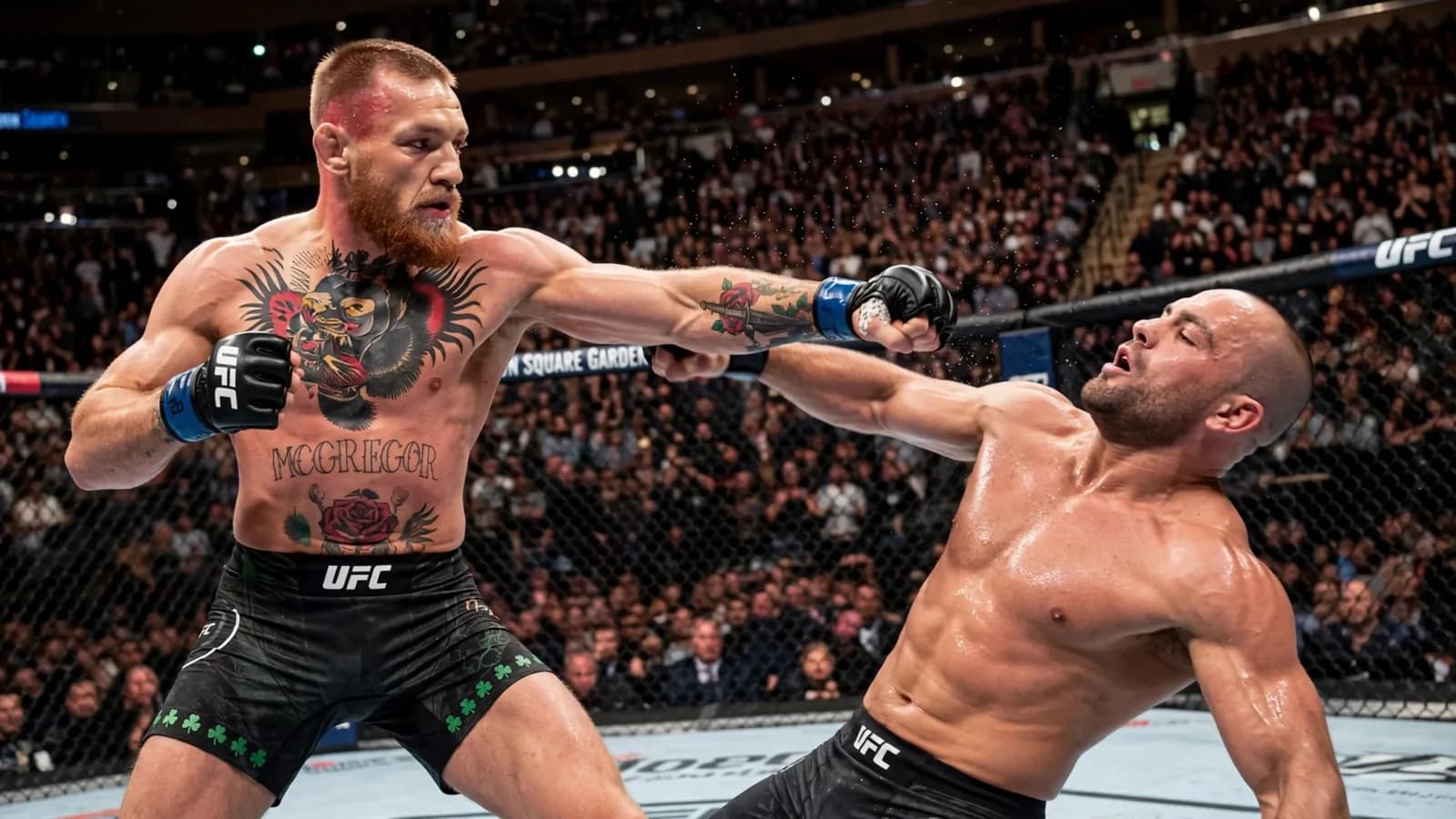
For most of its life the UFC could not legally hold its birthday party in the biggest market in America: professional MMA was banned in New York for nearly twenty years. The state lifted the ban in 2016, and the UFC marked its first New York City card the way it marks everything it cares about — with excess. UFC 205, at Madison Square Garden on November 12, stacked three title fights, drew 20,427 people and a $17.7 million gate, the largest in the Garden's history and the UFC's. Then Conor McGregor made the numbers look like the undercard.
McGregor, the featherweight champion, was challenging Eddie Alvarez for the lightweight title — an attempt to become the first fighter ever to hold two UFC belts at once. What he produced is generally considered the finest performance of his career, and one of the finest title-winning performances ever: three knockdowns of Alvarez in the first round alone, the champion bounced up twice and saved by survival instinct the third time. In the second round McGregor put his hands behind his back and invited the champion of the world to hit him. Then he countered with a four-punch combination and put Alvarez out.
The promotion had forgotten to bring the featherweight belt to the cage, so Dana White borrowed Tyron Woodley's welterweight strap for the photograph — two belts over two shoulders, one of them not even his — and McGregor delivered the era's defining sentence: "I've spent a lot of time slaying everybody in the country. I'd like to take the chance to apologize — to absolutely nobody! The double champ does what the fuck he wants!"
Underneath history, the card had depth: Tyron Woodley kept his welterweight title in a majority draw with Stephen Thompson, and Joanna Jędrzejczyk outlasted Karolina Kowalkiewicz to keep the strawweight belt. But the night is singular. The sport returned to New York on its 23rd birthday and its biggest star performed its most iconic coronation. There are bigger gates now. There is still only one UFC 205.
2022 — The Boogeyman Collects
Six years later, November 12 at the Garden again — 20,845 people, an $11.56 million gate — and the middleweight title fight at UFC 281 was built on a haunting. Israel Adesanya, champion since 2019, five defenses deep, had lost to exactly one man in combat sports, twice: Alex Pereira, who had beaten him in kickboxing by decision and then knocked him out, the only knockout loss of Adesanya's life. Pereira followed him into MMA and was fast-tracked to a title shot after just three UFC fights, because the storyline was also a threat assessment.
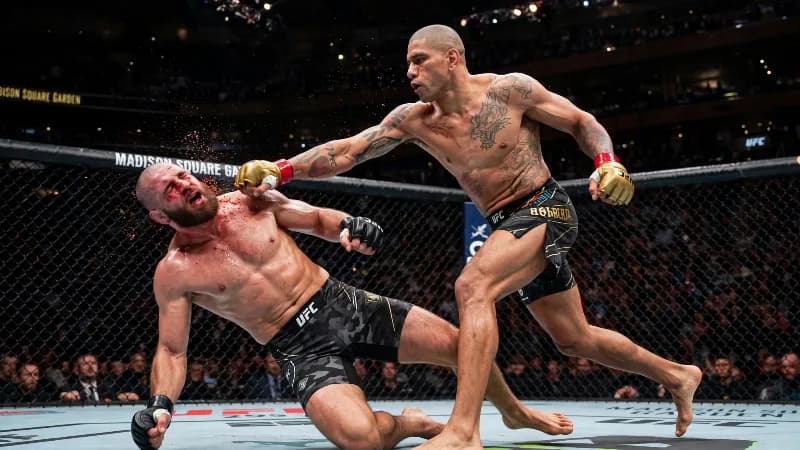
For four rounds, Adesanya handled it like a champion authoring his own exorcism. He rocked Pereira at the end of the first round, wrestled him for long stretches — more than six minutes of control time — and entered the fifth ahead 39–37 on all three scorecards. The boogeyman had one round left, and he spent it the way he had spent the kickboxing rivalry: walking forward. Pereira cut the cage, chopped the calf until Adesanya's movement dulled, and then the left hook landed and the champion was against the fence, and the barrage that followed — hooks and uppercuts, Adesanya slumped and covering — forced Marc Goddard to stop it at 2:01 of the fifth round.
"For everybody that said I couldn't do five rounds," Pereira said, through an interpreter, "look at what I did just now." Three and oh against the same man, in two sports, the last one for his belt, in the fifth round of a fight he was losing: there has never been a rivalry in MMA with a cleaner arrow. The first kickboxer to take Adesanya's zero had followed him across disciplines to take his crown on the sport's birthday, in the building where its biggest star had once held two belts up at once.
The undercard of history kept pace. Zhang Weili choked out Carla Esparza in the second round to regain the strawweight title. Dustin Poirier submitted Michael Chandler in the third round of the night's Fight of the Night. And Frankie Edgar — a champion of the era between Gracie and McGregor, fighting his retirement bout — was knocked out by a Chris Gutierrez knee at 2:01 of the first round. The main event would end at 2:01 of the fifth. Even the clocks in the Garden were rhyming that night.
Also on this day
- 2016, New York: Yoel Romero knocked out former middleweight champion Chris Weidman with a flying knee on the UFC 205 main card.
- 2022, New York: Dan Hooker stopped Claudio Puelles with body kicks in the second round to open the UFC 281 main card.
- 1993, Denver: Gerard Gordeau's 26-second head-kick knockout of Teila Tuli — the first finish in UFC history — opened the tournament that Royce Gracie closed.
The sport was born on November 12, crowned its first double champion on November 12, and watched its most haunted title change hands on November 12. If MMA ever builds a hall of fame with a single day on the door, this is the day.