The pioneer: Gina Carano
Gina Carano's professional debut came in June 2006, in World Extreme Fighting, in the first women's MMA fight in the state of Nevada. She knocked out Leiticia Pestova in 38 seconds.
“Cris Cyborg against Gina Carano was the first women's fight to headline a major MMA event, with the newly created Strikeforce featherweight title at stake.”
The setting of that debut matters as much as the result. Nevada is the state most associated with regulated combat sports in the United States, and the first women's MMA fight in the state was a threshold: once women's MMA had taken place there, under regulation, it was harder to treat it as something that happened elsewhere, outside the sport's mainstream. A 38-second knockout made the point even harder to ignore — a debut that ends that quickly invites a question about who can possibly stand up to her next, not a debate about whether she belongs.
Carano arrived at her defining fight unbeaten, with seven wins and no defeats. She was not a curiosity act. She was a fighter with a following, a style built for television, and a record that demanded a real opponent. Seven wins and no defeats is not a prospect's record; it is a contender's record, and it created a problem the sport had to solve. A fighter that good, with that kind of following, cannot keep fighting opponents who are not her equal — the audience stops believing the contest. Carano's record did not merely earn her a big fight. It demanded one, and an opponent who could plausibly beat her.
The night that changed everything: Carano vs. Cyborg, 2009
That opponent arrived on 15 August 2009, at Strikeforce's event at the HP Pavilion in San Jose, California. Cris Cyborg against Gina Carano was the first women's fight to headline a major MMA event, with the newly created Strikeforce featherweight title at stake.
Cyborg won by technical knockout with one second remaining in the first round. Around 14,000 fans attended, and the fight set a Showtime MMA audience record at the time. The message was unmistakable: a women's main event could carry a major card.
The UFC opens the door: UFC 157, 2013
The UFC's first women's fight came on 23 February 2013, at the Honda Center in Anaheim, California. Ronda Rousey against Liz Carmouche, for the newly created UFC bantamweight title (135 pounds), was the first women's bout in UFC history.
Rousey was the defending champion in all but name: the title had been awarded to her at a press conference before a UFC on Fox event on 6 December 2012, after her run as Strikeforce bantamweight champion. She won by armbar, with the submission coming at 4:49 of the first round.
The event drew 13,257 fans, a gate of 1,350,191 dollars, and 450,000 pay-per-view buys. The numbers said what the fight had already said: women's MMA was not a side attraction. Each number answers a different doubt: attendance says people came to the building, the gate says they paid serious money to do so, and the pay-per-view buys say the audience extended far beyond Anaheim, to viewers who paid to watch a card headlined by a women's title fight.
Ronda Rousey: the first superstar
Rousey's background was judo — she won an Olympic bronze medal in 2008 — and she became the first woman to sign a UFC contract, in November 2012. She won her first six professional fights by first-round armbar submission.
Her speed became its own record: she submitted Cat Zingano in 14 seconds at UFC 184 on 28 February 2015, the fastest women's victory in UFC history at the time. Fourteen seconds is a record that needs no embellishment, but its context makes it more remarkable: Zingano was a top contender, and the fight was a title defence on a major card. To finish a fight of that importance in 14 seconds is to compress everything Rousey was known for — the judo, the armbar, the first-round finishing instinct — into a single exchange.
Rousey's reach extended beyond her own fights. On 4 September 2013, season 18 of The Ultimate Fighter featured women as competitors and as head coaches for the first time, with Rousey and Miesha Tate leading the teams. And on 12 December 2014, in the season 20 finale, Carla Esparza beat Rose Namajunas to become the UFC's first strawweight champion — a division that existed because the women's game had grown past a single weight class. Season 18 showed the women's game had a roster, a coaching structure, and a pipeline; the strawweight division, a year later, showed it had depth by weight class — more than one division to fill, beyond the single bantamweight title contested at UFC 157.
Holly Holm: the knockout heard around the world
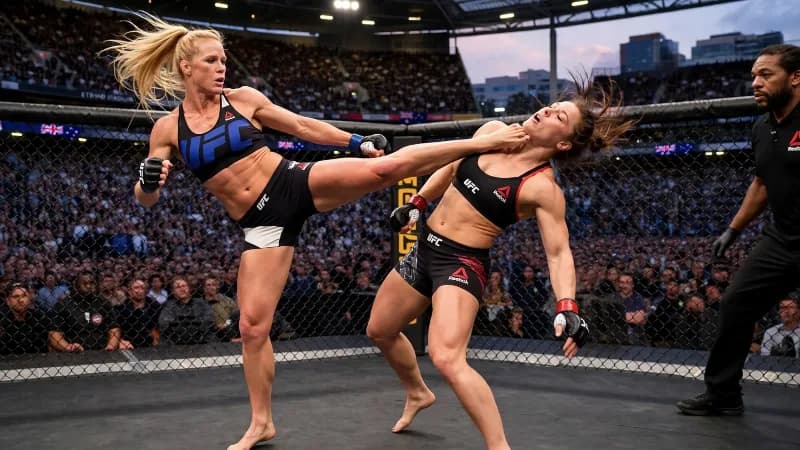
The Rousey era ended on 15 November 2015 local time (14 November in the United States), at Etihad Stadium in Melbourne, Australia, at UFC 193. Holly Holm, a former world boxing champion, knocked out Ronda Rousey with a left head kick at 59 seconds of the second round and won the bantamweight title.
Rousey arrived unbeaten, with twelve wins and no defeats; Holm arrived unbeaten as well. The attendance of 56,214 was a UFC attendance record at the time, passing the 55,724 of UFC 129 on 30 April 2011. The upset did not shrink women's MMA. It proved the division had depth — that a champion could fall and the sport would keep growing.
The fuller story is in the numbers around the kick. Rousey's twelve wins and no defeats meant she arrived as the most dominant champion the women's game had known. Holm's unbeaten arrival meant the challenger was not a sacrificial opponent but a genuine threat. And the record attendance of 56,214 meant the biggest live audience in UFC history to that point had gathered to watch a women's title fight. That is the measure of how far the sport had travelled since Carano's debut: from a first women's fight in Nevada to a record-breaking stadium crowd in Melbourne for a women's championship. When a dominant champion falls, a shallow division collapses with her. Women's MMA did not collapse after UFC 193, because the division now had other champions, other contenders, and other stories ready to take the main-event slot.
Amanda Nunes: the era of "The Lioness"
If Rousey was the first superstar, Amanda Nunes was the first complete champion. On 9 July 2016, at UFC 200 in Las Vegas, she submitted Miesha Tate with a rear-naked choke at 3:16 of the first round to win the bantamweight title.
Her first defense, on 30 December 2016 at UFC 207, was a 48-second knockout of Ronda Rousey in the first round. Then, on 29 December 2018 at UFC 232 in Inglewood, she knocked out Cris Cyborg in 51 seconds of the first round to become the first woman to hold UFC titles in two divisions at the same time, and the third fighter overall to do it. It was Cyborg's first defeat in more than thirteen years; Nunes's record at the time was 17–4.
Nunes did not just win. She beat the defining names of the divisions she ruled, and she did it quickly, in the first round, again and again.
Women's MMA goes global: Zhang and Shevchenko
The next stage was global. On 31 August 2019, in Shenzhen, China, Zhang Weili knocked out Jéssica Andrade technically at 42 seconds of the first round to become the first UFC champion born in China.
On 7 March 2020, at UFC 248 in Las Vegas, Zhang defended the title against Joanna Jędrzejczyk, winning by split decision after five rounds. The two combined for 351 significant strikes, the most in a women's UFC fight. It was the 2020 Fight of the Year, and in 2026 it became the first women's bout inducted into the UFC Hall of Fame's Fight Wing.
Zhang's two fights together show both sides of a champion. The title win in Shenzhen was a 42-second technical knockout — the kind of instant, emphatic finish that announces a new champion to the world, made historic by Zhang becoming the first UFC champion born in China, winning the title in China itself. The defence at UFC 248 was the opposite kind of classic: five full rounds, a split decision, and 351 significant strikes combined, the most in a women's UFC fight. One fight proved Zhang could end a championship bout in under a minute; the other proved she could win a five-round war against an elite opponent.
Valentina Shevchenko built the other pillar of the global era. On 8 December 2018, at UFC 231 in Toronto, she beat Joanna Jędrzejczyk by unanimous decision, 49–46 on all three cards, to win the vacant flyweight title. She defended that title seven times in her first reign. Where Zhang's title win was a 42-second finish, Shevchenko's was a five-round masterclass against the same Jędrzejczyk; where Zhang's defining defence was a single war, Shevchenko's defining achievement was sustained dominance — seven defences of a title that can feel provisional until someone defends it. Between them, Zhang and Shevchenko gave the global era its two shapes: the explosive new champion from China, and the dominant long-reigning flyweight champion.
From a 38-second debut in Nevada to title fights in Shenzhen, Toronto and Las Vegas, women's MMA traveled further in two decades than most sports travel in a century. It began with a pioneer proving a point. It became a sport where the champions — Rousey, Holm, Nunes, Zhang, Shevchenko — are not footnotes to the men's divisions, but the main story in their own right.