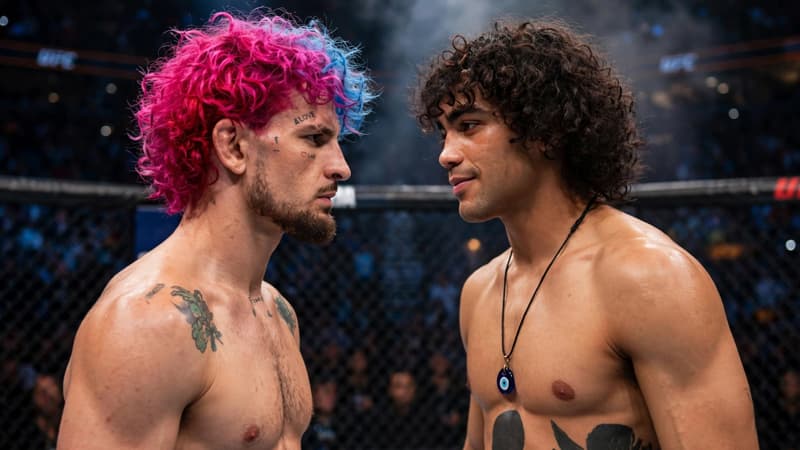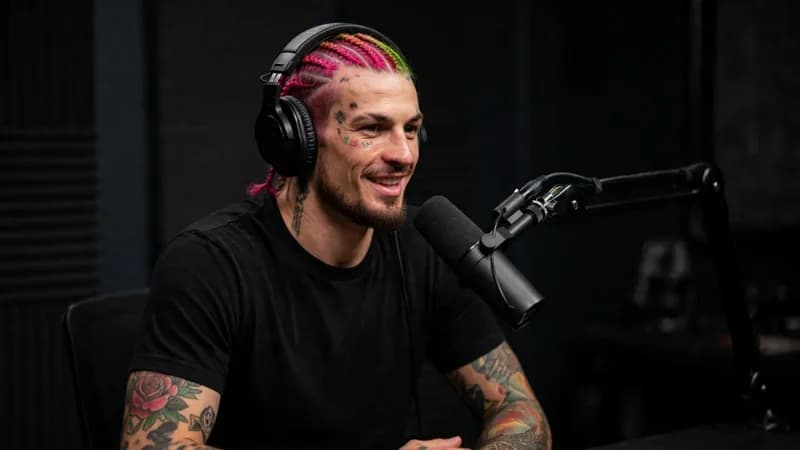
"I just knew this is what I was meant to be doing."
“O'Malley isn't going to be a star; he IS a star!”
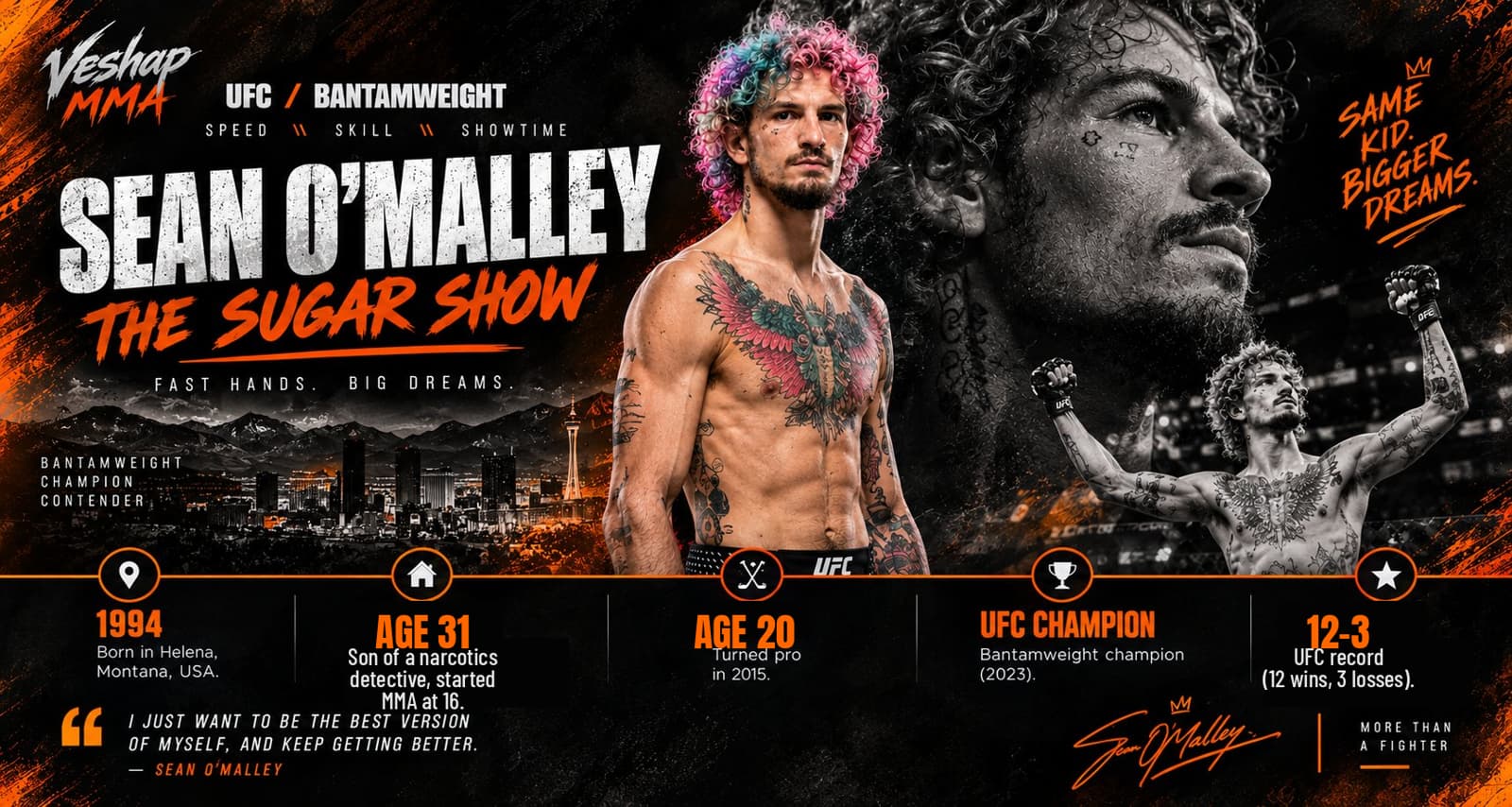
Sean O'Malley was sixteen years old when he walked into a kickboxing gym in Helena, Montana. He wasn't a phenom. He wasn't a prodigy scouted from some wrestling dynasty. He was a skinny kid from a small town that doesn't produce UFC champions — a kid who, just a few years earlier, had thought watching people fight was disgusting.
Let that sink in. The flashiest, loudest, most unapologetic showman in MMA grew up as the middle child of a narcotics detective and a nurse — and the first time he ever saw a UFC fight, he ran upstairs to tattle on his own father.
Born October 24, 1994, in Helena, Montana, Sean O'Malley came up the middle of four kids. His dad Dan was a narcotics officer with the Lewis and Clark County Sheriff's Office. His mom, a nurse, handles his finances to this day — "I don't trust anyone as much as I trust my mom when it comes to tax stuff," he once said.
The house sat just north of Helena, overlooking Lake Helena — five minutes from Black Sandy State Park, where the family spent every free weekend. Sounds idyllic. But Sean remembers it honestly.
"I definitely didn't grow up broke or rich," he told Sports Illustrated. "But money was the number one thing we all fought about in the family. We don't go out to eat, and if we do, we need to get something off the dollar menu."
He was a three-sport athlete — baseball, football, basketball — with an independent streak a mile wide. His dad put it bluntly: Sean wasn't a huge fan of coaches or organized teams. He knew early he had to showcase his talents — solo.
The attitude got him cut from the Capital High basketball team as a sophomore. Not for lack of skill. For attitude. That left him directionless. A season of football in Hamilton, a few more misadventures — and then, at sixteen, the kickboxing gym.
"I remember when I was 16 years old, I just went and started kickboxing, boxing and just kind of sparring," he said later. "And just kind of had this natural ability and I think some people are truly born knowing how to fight, and I found that and I became obsessed with it."
Before that, his dream had been the NFL — not romance, money. He wanted to be rich and famous. "Realized real quick that I was 5-11, 100 pounds, so I realized that wasn't realistic," he admitted. Then fighting showed up, and everything clicked. "I'm going to make money, this is how I'm going to do it. And it's literally all played out damn near perfect."
Montana has no sanctioning body for combat sports — and it's no pipeline to the UFC. O'Malley fought fourteen amateur fights there, sometimes three in a single month, in hotel conference rooms and small regional shows: Fightforce in Helena, Fusion Fight League in Sidney. He was knocking people out at sixteen, seventeen, eighteen, building the kind of cage time money can't buy.
He took his lumps too. In October 2013, Shea O'Neill submitted him with an armbar in Helena — his first career loss. Less than two months later, Myles Mazurkiewicz choked him out in Sidney at 145 pounds, a division above his natural weight. "That was O'Malley's final amateur loss," Montana Sports reported. "He didn't lose again for seven years."
But here's the detail that matters most: in August 2013, in Great Falls, O'Malley caught college wrestler Luis Carranza in an armbar with seconds left on the clock — "I literally only knew one arm bar off my back," he said. Watching from the commentary table was Tim Welch, a Montana veteran running the MMA Lab in Arizona. Welch approached him at the after-party and offered him a shot.
That night changed everything.
At nineteen, humbled by his first visit to Arizona — "I realized I was not nearly as good as I thought I was" — he went home, worked a care job, saved two thousand dollars, and moved to Phoenix for good. He never left.
Oh, and the name. His first coach in Helena, Johnny Aho, had two rules: no gym hoodie for six months, no nickname for six months. When the time came, Aho looked at the kid and said "Sugar." Why? "Because you're so sweet to watch." The kid respelled it "Suga." And when Aho told the sixteen-year-old that Sean O'Malley would be a household name, the kid didn't blink: "I will be the best in the world at 135. I'll be the world champion at 135." The rest is history.
He entered Dana White's Contender Series in the summer of 2017, undefeated at 7-0 as a pro. On July 18, at the UFC Training Center in Las Vegas, he co-main-evented Dana White's Tuesday Night Contender Series 2 against Alfred Khashakyan. The end came at 4:14 of the opening round — a walk-off right hand, his sixth first-round finish. He walked away the moment it connected.
Dana White stood up. He'd seen enough. "I liked a lot of guys… but I'm looking for somebody who has that thing," White said. "Sean O'Malley has that thing." The lone contract of the night.
And then came Snoop Dogg. Guest-commentating, Snoop lost his mind over the knockout — "Three piece dinner with biscuits, O'MALLEY!" — and invited the kid to his trailer to smoke afterward. Walking past White backstage, the kid grinned: "Welcome to the Suga Show."
The Suga Show was officially open for business.
The UFC run started with fireworks and adversity in equal measure. He won his first two UFC fights — Terrion Ware, then Andre Soukhamthath at UFC 222, where he broke his foot in the third round and did the postfight interview with Joe Rogan from his back. "I love this game," he told Rogan through the pain. "I love the talk, I love the media. I love everything about this sport. And I f***ing love you, Joe Rogan."
Then came the lost years. In 2018, O'Malley tested positive for Ostarine — trace amounts, across multiple tests. USADA ultimately ruled the findings consistent with unintentional use, but the process dragged for the better part of two years. He couldn't fight until the agency sorted it out. "I was depressed, definitely," he said. "Every time my manager calls me or texts me now, I get this sick feeling in my stomach."
He came back at UFC 248 in March 2020, knocked out Jose Quinonez — then ran into Marlon Vera at UFC 252 that August and got stopped after his leg went dead from an injury late in the first round. The first loss of his professional career.
Here's what separates the real ones, though: O'Malley didn't fold. He went back to the lab with Tim Welch, fixed the holes, and went on a tear. The split-decision win over former champion Petr Yan at UFC 280 in Abu Dhabi in October 2022 punched his ticket to the title shot everyone said he hadn't earned.
August 19, 2023. TD Garden, Boston. UFC 292. Champion Aljamain Sterling — a machine coming off three straight title defenses.
O'Malley spent round one getting reads. Early in round two, Sterling overextended on a straight left. O'Malley countered with a picture-perfect right cross that sent the champion sprawling onto all fours. Standing-to-ground hammerfists. Referee Marc Goddard stepped in at 0:51 of the round. It was over.
Sterling's first loss in nearly six years. The Suga Show had the belt.
Dana White didn't mince words: "O'Malley got the title shot because he earned it… O'Malley isn't going to be a star; he IS a star!" The Boston gate did seven million dollars — the biggest bantamweight championship fight in pay-per-view history.
One defense followed: a unanimous decision over Marlon Vera at UFC 299 in Miami in March 2024, the loss avenged. Then the machine arrived. At UFC 306 — Noche UFC, the Sphere, Las Vegas, September 14, 2024 — Merab Dvalishvili smothered him for five rounds and took the belt by unanimous decision (48-47, 48-47, 49-46).
The rematch came at UFC 316 on June 7, 2025, in Newark — in front of a cageside Donald Trump. O'Malley walked in healthy, recovered from September surgery on a torn labrum in his hip. It didn't matter. Dvalishvili dragged him down and locked in a north-south choke at 4:42 of round three.
The next day, O'Malley posted a simple message: "Sorry we didn't get the job done. We'll be back."
And he meant it.
2026 has been the comeback tour. On January 24, at UFC 324 in Las Vegas, O'Malley outpointed Song Yadong — 29-28 on all three cards — for his first win in nearly two years. "Petr Yan has something I want," he said afterward. "That's what I want next." Then in June, at the UFC's Freedom 250 at the White House, he starched Aiemann Zahabi with a second-round TKO.
Twenty and three, one no-contest. A two-fight streak. And the whole division holding its breath.
On October 24 — O'Malley's birthday — Petr Yan defends the bantamweight title against Merab Dvalishvili in their trilogy fight, UFC 333's co-main event in Abu Dhabi. O'Malley is tracking it like his whole career depends on it. Because it might.
"If Merab goes out there and wins, I would love to get that trilogy," O'Malley said, "but it's not what the fans want. It would be a great birthday present if Petr goes out there and wins."
Then there's Payton Talbott — the young killer who just finished Deiveson Figueiredo at UFC 332 and called O'Malley out by name: "You can't run forever." O'Malley's answer? Classic Suga. He'll fight Talbott only if Yan loses. "If Petr goes out there and wins, I'm ducking him for a tougher fight. I'm ducking him for Petr Yan." Read that again. Only O'Malley could make ducking sound like a flex.
You love to see it. From the kid who tattled on his dad for watching UFC DVDs… to the man who named his daughter Elena — throw an "H" on that and it's Helena, on purpose — to the biggest star at 135 pounds.
Montana never left him. He just took it with him to the top.