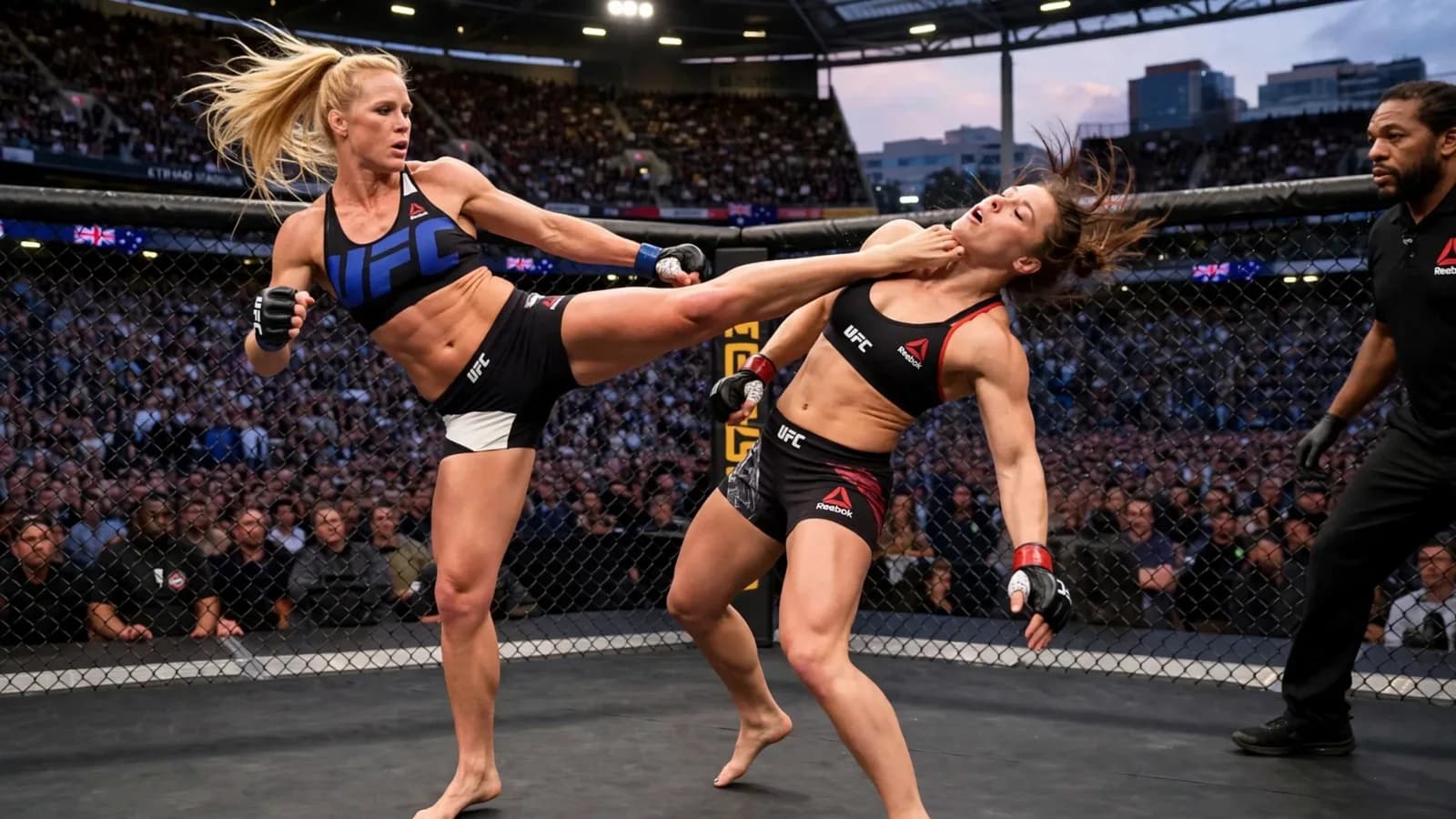
On This Day — November 15: Holm’s Kick Ends the Rousey Era at UFC 193
No date in the November calendar carries more heavyweight history per hour. In 2008 a professional wrestler with three fights took the UFC heavyweight title. In 2014 a 40-year-old kickboxer nearly did, and was undone by a flying knee. And in 2015, in front of the largest crowd the UFC had ever drawn, Ronda Rousey's era ended in 59 seconds of a second round in Melbourne. November 15 is the date the sport's certainties go to die.
No date in the November calendar carries more heavyweight history per hour. In 2008 a professional wrestler with three fights took the UFC heavyweight title. In 2014 a 40-year-old kickboxer nearly did, and was undone by a flying knee. And in 2015, in front of the largest crowd the UFC had ever drawn, Ronda Rousey's era ended in 59 seconds of a second round in Melbourne. November 15 is the date the sport's certainties go to die.
2015 — The kick
UFC 193 was built as a coronation tour. The UFC took Ronda Rousey — 12–0, six title defenses, all but one finished in the first round, the most famous fighter on earth — to a stadium in Melbourne and put 56,214 people in it, the biggest live audience in the promotion's history. Opposite her stood Holly Holm: 34 years old, a former world boxing champion in three weight classes, 9–0 in MMA but lightly regarded, a heavy underdog expected to be armbarred like the rest.
The first round rewrote the script in real time. Rousey did what she always did — charged, swung, hunted the clinch — and Holm, moving laterally behind a southpaw jab and oblique kicks, made her pay for every step. Rousey's lip was split; her timing was gone; the champion who ended fights in seconds was chasing a ghost and breathing hard. Fifty-nine seconds into the second round, Rousey ducked into a left high kick that landed on her neck and put her down cold. Holm added punches before Herb Dean arrived.
"There's been a lot of blood, sweat and tears but it was all worth it," Holm said, having collected the title, Fight of the Night and a Performance of the Night bonus in one evening. Rousey left for the hospital with a concussion and facial cuts and did not speak to the media. She would fight once more, a year later, and never win again. The upset drew comparisons to Buster Douglas over Mike Tyson — a champion so total that the loss itself became the most famous result of her career. The stadium crowd that came to see a legend saw an ending instead, and it remains the biggest one-night audience the sport has ever produced for a changing of the guard.
The tension had been visible a day earlier, when the two nearly came to blows at the weigh-in and had to be separated — Rousey, usually the intimidator, swinging emotionally at an opponent who would not be moved. The preparation was the whole fight: a camp built entirely around the champion's aggression, distance as a weapon, and one kick rehearsed for the moment the most feared woman in sports ducked her head one time too many.
The co-main event made the card a double landmark: Joanna Jędrzejczyk defended the strawweight title against Valérie Létourneau, 49–46, 49–46, 50–45 — the first UFC card ever headlined by two women's title fights. Létourneau gave the champion her hardest test to that point, starting strongly, controlling stretches of the first two rounds and even taking Jędrzejczyk down, a sight almost never seen. But the champion's volume compounded like interest: combinations upstairs, kicks that left her challenger's lead leg welted and raw, a welt under Létourneau's eye. The Canadian traded to the final horn and still lost clearly — which told its own story about the level Jędrzejczyk had already reached.
2014 — The knee
A year earlier to the day, Mexico City hosted the UFC for the first time, and nearly got the sport's most romantic heavyweight story. Cain Velasquez, the champion, withdrew injured; Mark Hunt, 40 years old, three weeks to prepare and forty pounds to cut, flew in to fight Fabrício Werdum for the interim title at altitude, in front of 21,000 people.
The run needed context to be believed. In 2010 Hunt had lost six straight fights, all by first-round stoppage, and the UFC had been willing to buy out his old PRIDE contract and let him walk away. He refused, stayed, and rebuilt himself win by win until, at 40, he was the man flown across the world on three weeks' notice to save a main event in Mexico. For a round, the fairy tale was on. Hunt dropped Werdum with a right hand — twice — and each time waved the jiu-jitsu champion back to his feet rather than follow him into the guard. The arena believed. Then, midway through the second round, Werdum shot a fake takedown; Hunt lowered his head to defend it, and Werdum launched a flying knee that met him on the way down. Punches followed at 2:27 of the round. The grappler had knocked out the kickboxer with the kickboxer's own poetry, and the most unlikely title run in heavyweight history ended one strike short. Werdum unified the title against Velasquez the following June, in the same city — the knee in November had only been the trailer.
2008 — The takeover
The date's third pillar is where the heavyweight weirdness began. At UFC 91 in Las Vegas, Brock Lesnar — a WWE star with a 2–1 professional record — challenged Randy Couture for the heavyweight title and stopped him with punches at 3:07 of the second round, a right hand behind the ear and hammerfists on the mat. Lesnar was champion in his fourth professional fight, and 1.01 million people bought the pay-per-view to see whether it could happen. It could. The bout was an experiment the sport ran on itself: could a giant athlete with almost no fight mileage simply arrive and take the crown from a 45-year-old master tactician? The answer reset the heavyweight division's economics overnight — Lesnar became its biggest pay-per-view draw, and the title he seized in four fights he would defend in the two largest-selling events of the era. On the same undercard, a young Brazilian named Rafael dos Anjos made his UFC debut and was knocked out in the third round by Jeremy Stephens; in 2015 he would hold the lightweight title, and in 2020 he would headline November 14's card — but that is another date's story, one day early.
Also on this day
- 2015, Melbourne: Mark Hunt knocked out Antônio Silva in the first round of their rematch, two years after their five-round draw.
- 2015, Melbourne: Robert Whittaker outpointed Uriah Hall — the future middleweight champion's climb, visible in plain sight.
- 2014, Mexico City: Kelvin Gastelum submitted Jake Ellenberger with a first-round rear-naked choke in the co-main event.
Notice, too, the date's connective tissue: Mark Hunt lost a heavyweight title fight on November 15, 2014, and won on the undercard of November 15, 2015; Randy Couture lost his crown on the date in 2008 and won a main event on November 14, 2009, one day and one year removed; Rafael dos Anjos debuted on the date in 2008 and headlined its neighbor date in 2020. The calendar rhymes because the sport is small and its greats keep colliding with the same days.
Three heavyweight crowns touched, one empire ended, 56,000 people in a stadium and one left kick heard around the world: November 15 is not a date on the calendar. It is a fault line.