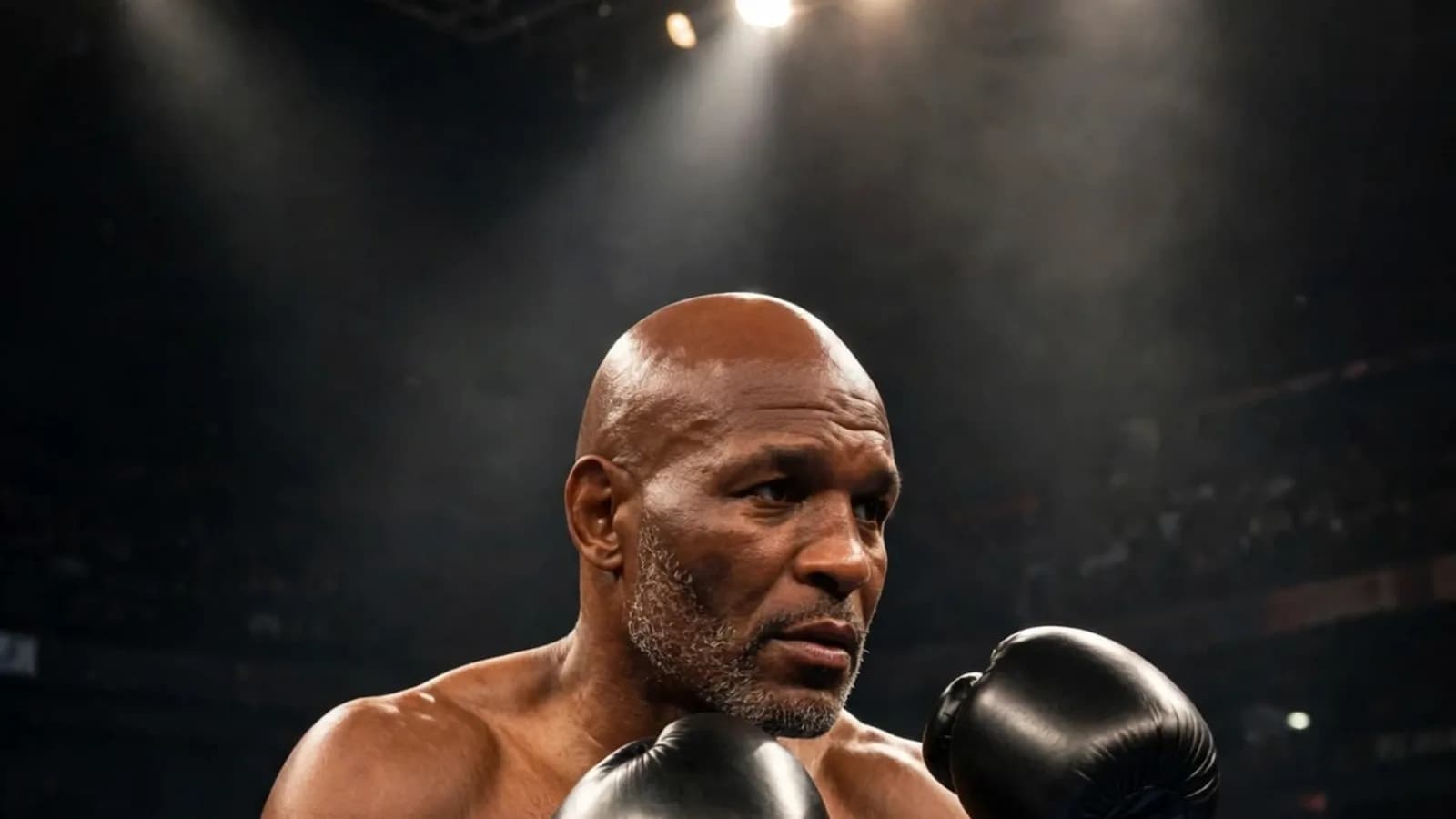
Bernard Hopkins: the Executioner who outlasted time
Twenty defences, three decades, one rule: nobody outlasted Bernard Hopkins.
Bernard Hopkins retired at 51, 55-8-2 with 32 knockouts, after a 28-year career from 1988 to 2016. He held the middleweight title for a decade, defended it 20 times — a division record — then won world titles at light heavyweight at 46, 48 and 49. No boxer has ever won a world title older. The question is not how he won so much. It is how he lasted so long.
From Graterford to the championship
Born in Philadelphia on January 15, 1965, Hopkins came to boxing through prison. At 17 he was convicted of armed robbery and sentenced to 18 years in Graterford State Penitentiary. He served 56 months, took up boxing inside, and was released on parole in 1988. He lost his professional debut that October to Clinton Mitchell, then won his next 22 fights in a row.
His first title shot, in 1993, was a unanimous-decision loss to Roy Jones Jr for the vacant IBF middleweight title. On April 29, 1995, he stopped Segundo Mercado in the seventh round in Landover, Maryland, to win that belt. He would not lose it for a decade.
Twenty defences
The longest middleweight reign in history followed: 10 years and two months, 20 defences against 17 opponents. In February 2002, beating Carl Daniels, Hopkins passed Carlos Monzon's record of 14 consecutive middleweight defences, a mark that had stood for more than two decades.
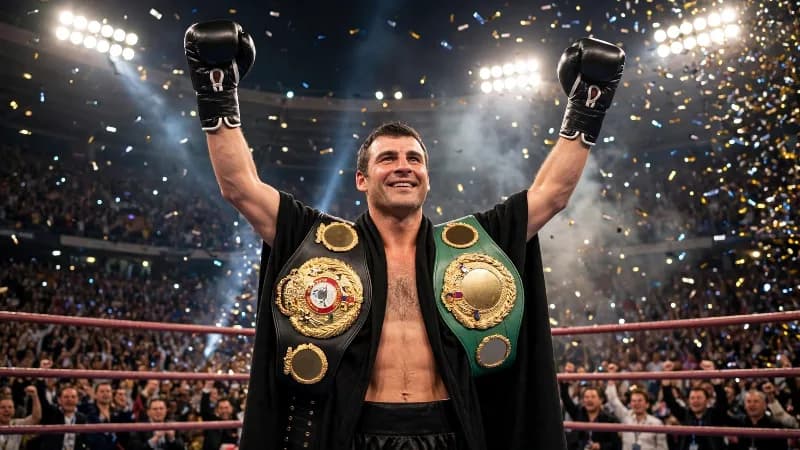
The reign's two defining nights came in 2001 and 2004. On September 29, 2001, at Madison Square Garden, Hopkins stopped the previously undefeated Felix Trinidad in the 12th round. Trinidad was 40-0 and a 2-1 favourite; Hopkins dropped him in the final round and his corner threw in the towel. Hopkins became the first undisputed middleweight champion since Marvin Hagler in 1987, and was named 2001 Fighter of the Year by The Ring and the Boxing Writers Association of America.
On September 18, 2004, in Las Vegas, Hopkins knocked out Oscar De La Hoya in the ninth round with a left hook to the body. The win made him the first man to hold all four major belts — IBF, WBC, WBA and WBO — at the same time, and it remains the first stoppage loss of De La Hoya's career.
The Taylor losses — and the move up
The reign ended narrowly: Hopkins lost his belts to Jermain Taylor in July 2005, and the rematch the same year, both on disputed decisions. He was 40. Most fighters would have retired. Hopkins moved up two weight classes instead.
On June 10, 2006, aged 41 and a 3-to-1 underdog, he beat Antonio Tarver by lopsided unanimous decision to win The Ring's light heavyweight championship. He outpointed Ronald "Winky" Wright in 2007 and, in October 2008, handed the previously undefeated Kelly Pavlik — 17 years his junior — a one-sided defeat. In April 2010 he outpointed Roy Jones Jr in their rematch, 17 years after their first fight.
The oldest champion in history
Then came the unprecedented part. In May 2011, Hopkins outpointed Jean Pascal in Montreal to win the WBC light heavyweight title at 46 — breaking George Foreman's 1994 record, set at 45, as the oldest boxer ever to win a world championship. Their first fight, five months earlier, had ended in a majority draw.
He broke his own record twice more. On March 9, 2013, in Brooklyn, he beat Tavoris Cloud by unanimous decision to win the IBF light heavyweight title at 48. On April 19, 2014, in Washington, he outpointed Beibut Shumenov on a split decision — at 49 years and 94 days — to become the oldest boxer ever to unify world titles, adding the WBA super title.
He lost both belts to Sergey Kovalev in November 2014, outpointed by a champion 18 years his junior. He was 49, and fought once more.
What made it last
Hopkins lasted because he had already survived worse. The prison years gave him his discipline: Britannica credits his longevity to a "career-long commitment to physical conditioning and mastery of virtually every aspect of his craft," and the Hall of Fame cites his "mental and physical acumen and intensity." In the ring that meant the Philly Shell — a shoulder-roll defence that let him slip punches and counter without taking damage — and a refusal to waste a punch, a step or a round. He did not out-punch younger men. He out-thought them until their youth ran out before his craft did.
The end came on December 17, 2016, at the Forum in Los Angeles, against Joe Smith Jr. Hopkins was 51. Smith caught him in the eighth round and sent him through the ropes; unable to return inside 20 seconds, he lost by technical knockout — the only stoppage defeat of his career. "I know the fans will know I went out as a soldier, fighting the toughest, baddest opponents," he said afterwards. "This is my last fight."
He was inducted into the International Boxing Hall of Fame in 2020. The numbers will stand for a long time. The lesson stands longer: the Executioner did not beat time. He outworked it, one disciplined round at a time, for 28 years.