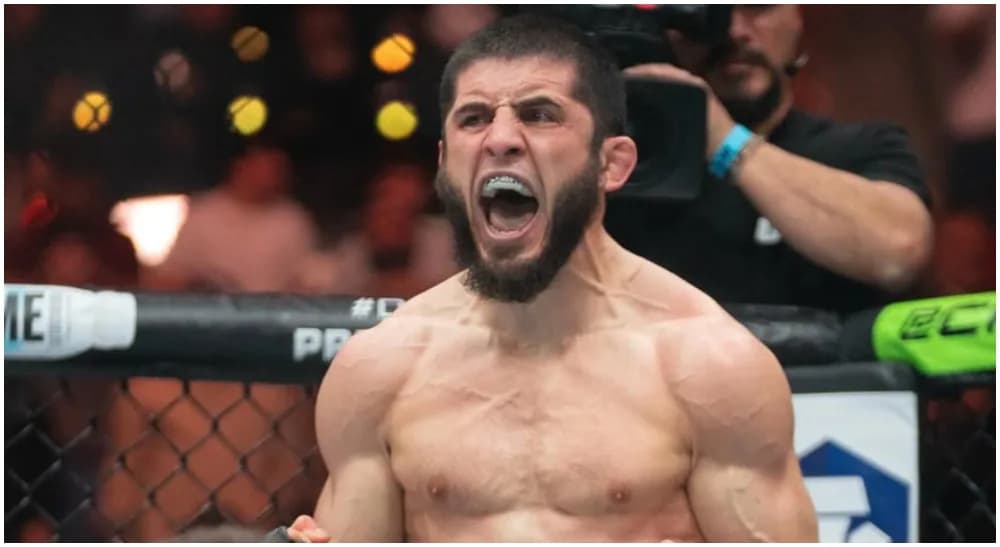
The answer is not simply that he is an elite wrestler. It is that every solution to his wrestling creates another problem. Islam Makhachev has reached a point where opponents can spend an entire training camp preparing for his greatest weapon — and still struggle to stop it. That is what makes him different. A fighter like Merab Dvalishvili can overwhelm opponents with relentless wrestling. A fighter like Alex Pereira can make every striking exchange dangerous. But Islam presents a more complicated problem: he can threaten you in almost every phase of the fight, and the danger in one phase makes the others more effective.
“"They know what Islam wants to do. They know the wrestling is coming. They know the control is coming. They know the submissions are coming. And knowing has not been enough."”
1. His wrestling is not one attack. It is a chain of problems.
Against an ordinary wrestler, defending the first takedown may be enough. Against Islam, it is often only the beginning. He can attack the legs, change levels, work from the clinch, drive opponents toward the cage, and transition between takedown attempts without giving them much time to reset. Even when the first attempt fails, the opponent may still be defending a second attempt — or trying to avoid being dragged into a position where Islam can control the exchange. This is the difference between having a good takedown and having a complete wrestling system. Islam does not need every attempt to succeed. He needs to keep forcing defensive decisions until one of them breaks down.
2. The threat of the takedown changes the striking.
This is where his game becomes especially difficult to solve. When an opponent knows that a takedown is coming, he cannot simply stand in the perfect position to throw punches. He has to think about his stance, his balance, his distance, his reaction to level changes, whether a combination leaves his legs exposed, and whether moving backward takes him closer to the cage. That hesitation matters. Islam can use the threat of wrestling to make opponents more predictable on the feet. And once they become concerned about the takedown, his striking becomes more effective. The wrestling does not merely take away an opponent's options. It makes his striking better.
3. He is no longer just a grappler who can strike.
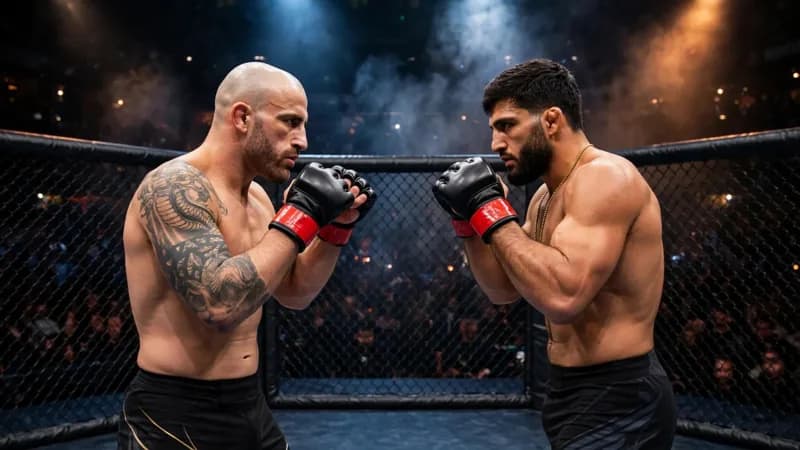
This is probably the biggest difference between Islam and the version of him that entered the UFC. His striking has developed into a genuine weapon. He can work behind a jab, land straight punches, attack with kicks, and punish opponents who become too focused on defending takedowns. That creates a difficult choice: stand too close, and you risk being taken down. Stand too far away, and Islam can control the distance with his striking. Attack aggressively, and you may expose yourself to a counter or a takedown. There is no perfect range where the opponent can simply relax. And unlike a fighter whose entire game depends on getting the fight to the ground, Islam has shown that he can win striking exchanges against high-level opponents. His knockout of Alexander Volkanovski at UFC 294 was a particularly important example of that evolution.
4. His positional control makes every mistake expensive.
Getting taken down is not necessarily the worst thing that can happen in MMA. Getting taken down by Islam — and then being unable to escape before he improves his position — is a different problem. His grappling is built around control, pressure and transitions. He can move from a takedown into a dominant position, threaten submissions, attack the back, or force an opponent to spend energy defending rather than attacking. That means an opponent is not simply trying to get back to his feet. He is trying to escape while protecting his neck, defending submissions, avoiding giving up his back, preventing Islam from improving position, and managing fatigue. One mistake can turn a relatively safe position into a fight-ending sequence.
5. He does not need to win every exchange to win the fight.
This is an underrated part of Islam's style. Some fighters need to create chaos. They need a high pace, big exchanges and constant offensive output. Islam often does the opposite. He can remain patient, wait for the right moment, and choose when to engage. His style is not built around winning every second of the fight. It is built around winning the exchanges that matter most. That makes him difficult to bait. If an opponent becomes frustrated and starts forcing attacks, Islam can use that impatience against him. If the opponent becomes too cautious, Islam can take control of the pace. He is comfortable making the fight happen on his terms.
6. His opponents cannot simply copy the Volkanovski game plan.
Alexander Volkanovski showed that Islam can be challenged. Their first fight at UFC 284 was competitive, and Volkanovski's ability to defend takedowns, move intelligently and create striking exchanges demonstrated that Islam was not untouchable. But there is an important distinction between finding a successful approach and being able to reproduce it consistently. Volkanovski had an exceptional combination of elite takedown defense, balance, fight IQ, movement, timing, and the ability to remain dangerous while defending. Most fighters do not possess that exact combination. And even Volkanovski could not simply repeat the same performance in their rematch, where Islam finished him in the first round at UFC 294. That is what makes the matchup so difficult: the opponent needs a very specific set of skills, and even then, Islam can adjust.
7. He has become more dangerous without becoming reckless.
This may be the most important characteristic of his evolution. Islam has improved his striking, but he has not abandoned the control that made him elite. He does not need to turn every fight into a brawl to prove he can strike. He can use his striking when it is advantageous, return to wrestling when it is advantageous, and avoid unnecessary risks when neither is necessary. That is a rare combination. Many fighters become more dangerous by becoming more aggressive. Islam has become more dangerous by becoming more complete.
So what is the real answer?
Islam Makhachev is difficult to beat because he does not give opponents a single problem to solve. He gives them a sequence of problems. Defend the takedown, and you may expose yourself to striking. Focus on the striking, and you may expose yourself to wrestling. Escape the takedown, and you may still have to defend another attempt. Get back to your feet, and you may have spent valuable energy doing it. Try to force the pace, and you may create the opening he has been waiting for. That is why his dominance is so impressive. He does not simply impose one style on opponents. He makes every style of fighting against him more difficult. And perhaps the most frustrating part for his opponents is this: they know what Islam wants to do. They know the wrestling is coming. They know the control is coming. They know the submissions are coming. And knowing has not been enough.